 English
 中文简体
中文简体 日本語
日本語 Español
 عربى
عربى
Search
Categories
Recommend
Categories
 Lin Yuxi — International Product Sales Manager
Recommend
-
 Industry news
 -
 Industry news
 -
 Industry news
 -
 Industry news
Oct 10, 2026 - By admin
Anti-Scald Stainless Steel Kettle for Modern Tea Brewing and Everyday Hydration
Content
- 1 Introduction
- 2 Product Overview
- 3 Design Philosophy: Traditional Tea Culture Adapted for Modern Life
- 4 316L Stainless Steel Construction
- 5 Vacuum Insulation for Heat Retention
- 6 Dual-Rotation Inner Lid and 360-Degree Pouring
- 7 Magnetic Outer Lid as a Protective Cover and Tea Cup
- 8 Filter Screen and Steeping Performance
- 9 Comparison with Competing Product Types
- 10 Manufacturing Capabilities and Industrial Strength
- 11 Material and Component Specification
- 12 Ergonomics and Daily User Experience
- 13 Applications Across Different Environments
- 14 Customization and Private-Label Opportunities
- 15 Procurement Considerations for Buyers
- 16 Care, Maintenance, and Responsible Use
- 17 Frequently Asked Questions
- 17.1 What is the main purpose of this kettle?
- 17.2 What materials are used in the main body?
- 17.3 What capacities are available?
- 17.4 How does the dual-rotation inner lid work?
- 17.5 Can the outer lid be used as a cup?
- 17.6 Is the product suitable for loose-leaf tea?
- 17.7 Why is 316L stainless steel advantageous?
- 17.8 Does vacuum insulation keep tea hot indefinitely?
- 17.9 Is the kettle completely spill-proof?
- 17.10 Can the kettle be customized?
- 17.11 Who can benefit from this product?
- 17.12 What should buyers evaluate before placing an order?
- 18 Conclusion
- 19 References
- 20 Product: Anti-scald Home Stainless Steel Kettle
Introduction
The way people prepare and enjoy hot drinks is changing. Traditional tea brewing remains important, but modern users also expect convenience, safety, reliable temperature retention, easy cleaning, and a product that can move smoothly between home, office, travel, and outdoor environments. The Anti-Scald Home Stainless Steel Kettle is designed for this combination of traditional function and contemporary practicality. It brings together vacuum insulation, a stainless steel steeping system, a controlled pouring mechanism, and a magnetic outer lid that can also serve as a small drinking cup.
With capacities of 0.8 liters and 1.35 liters, the kettle is suitable for personal use, shared office use, family tea service, and portable outdoor beverage preparation. Its body, inner liner, filter, and outer lid are made from 316L stainless steel, while the inner lid combines 316L stainless steel with Tritan. This material selection gives the product a strong foundation for corrosion resistance, repeated use, and neutral beverage contact.
Unlike a basic vacuum flask, the kettle is designed around the experience of steeping. Tea leaves, small green-tangerine peel, black tea, and similar ingredients can remain inside the vessel while hot water extracts their flavor and aroma. Unlike a conventional teapot, the product is insulated and portable. Unlike a simple travel mug, it is equipped for controlled steeping and a more flexible serving ritual.
The product also reflects the manufacturing capabilities of Heenoor Co., Ltd., a drinkware manufacturer established in 1999. The company integrates product design, engineering validation, tooling development, standardized production, and quality management. Its experience with stainless steel, titanium, plastic, and glass drinkware allows it to support products that must balance appearance, functionality, material performance, and production scalability.
This article examines the kettle’s design, material advantages, user benefits, manufacturing considerations, customization potential, and suitability for professional procurement programs. It also explains why the product offers a meaningful advantage over ordinary insulated bottles, traditional teapots, and low-cost kettles with simpler lid structures.
Product Overview
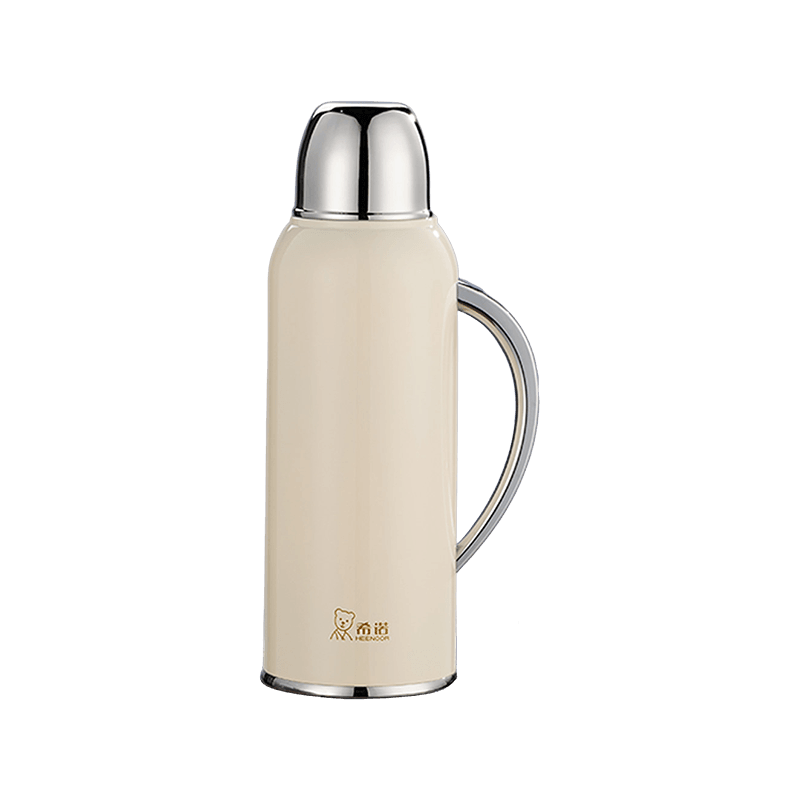
The Anti-Scald Home Stainless Steel Kettle is a vacuum-insulated beverage vessel developed for hot water, tea steeping, and convenient pouring. It is available in two capacities under model series XN-2033 / 2035. The 0.8-liter version weighs approximately 0.65 kilograms, while the 1.35-liter version weighs approximately 0.84 kilograms. These sizes provide a practical choice between personal portability and larger-volume serving.
The main structural components include a 316L stainless steel outer lid, outer shell, inner liner, and filter screen. The inner lid is constructed from 316L stainless steel and Tritan. A silicone rubber sealing ring helps support closure and liquid retention, while the handle is made from electroplated ABS. The combination is intended to create a product that feels solid, functions reliably, and remains manageable during daily use.
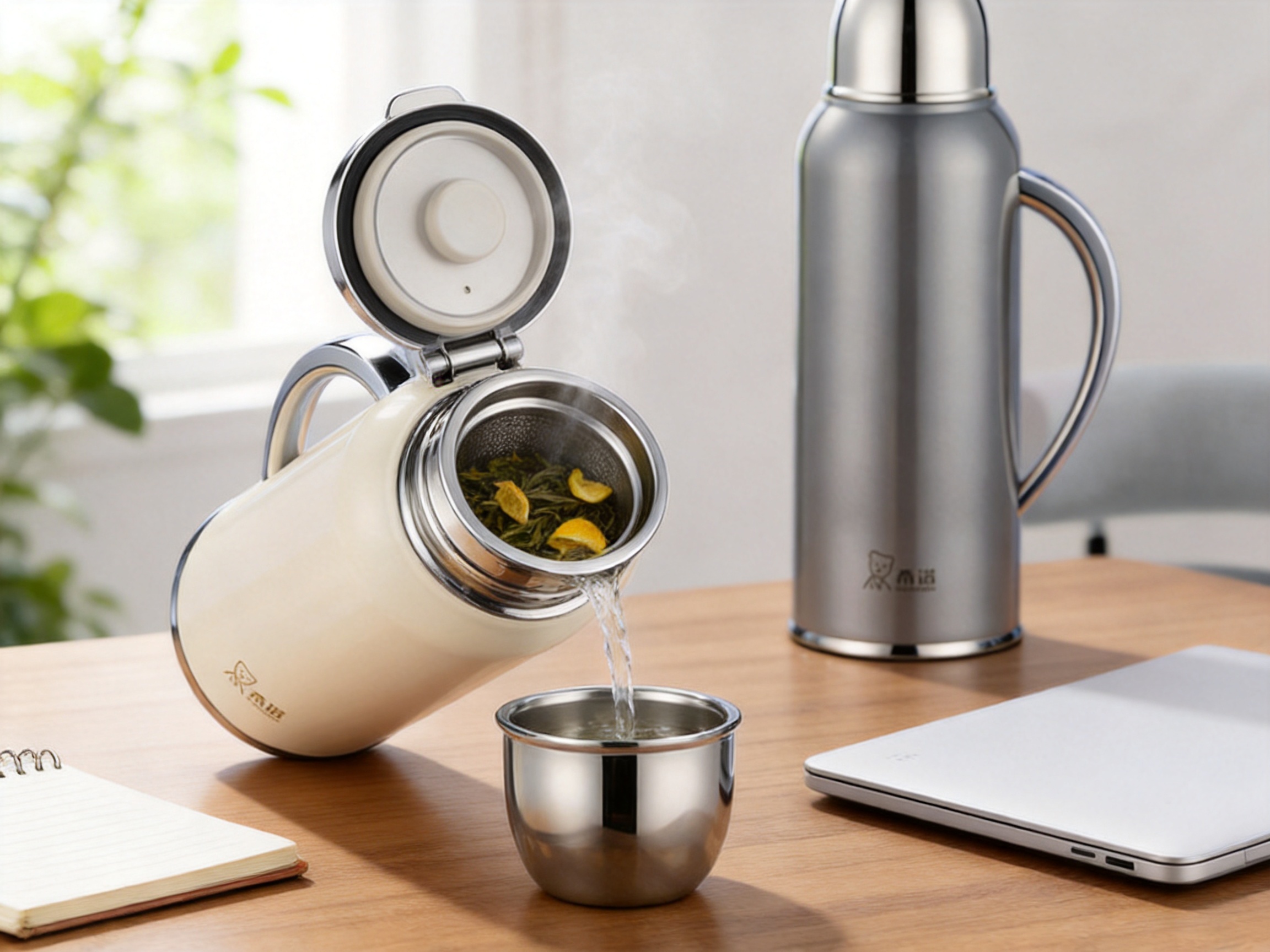
The lid assembly is one of the kettle’s defining features. A dual-rotation inner lid controls the opening and closing of the internal flow path. The user turns the mechanism in one direction to open it for pouring and in the opposite direction to close it. The product is designed to allow 360-degree pouring, meaning the kettle does not require a fixed pouring orientation. This is particularly useful when serving several people or when the kettle is placed on a crowded desk or table.
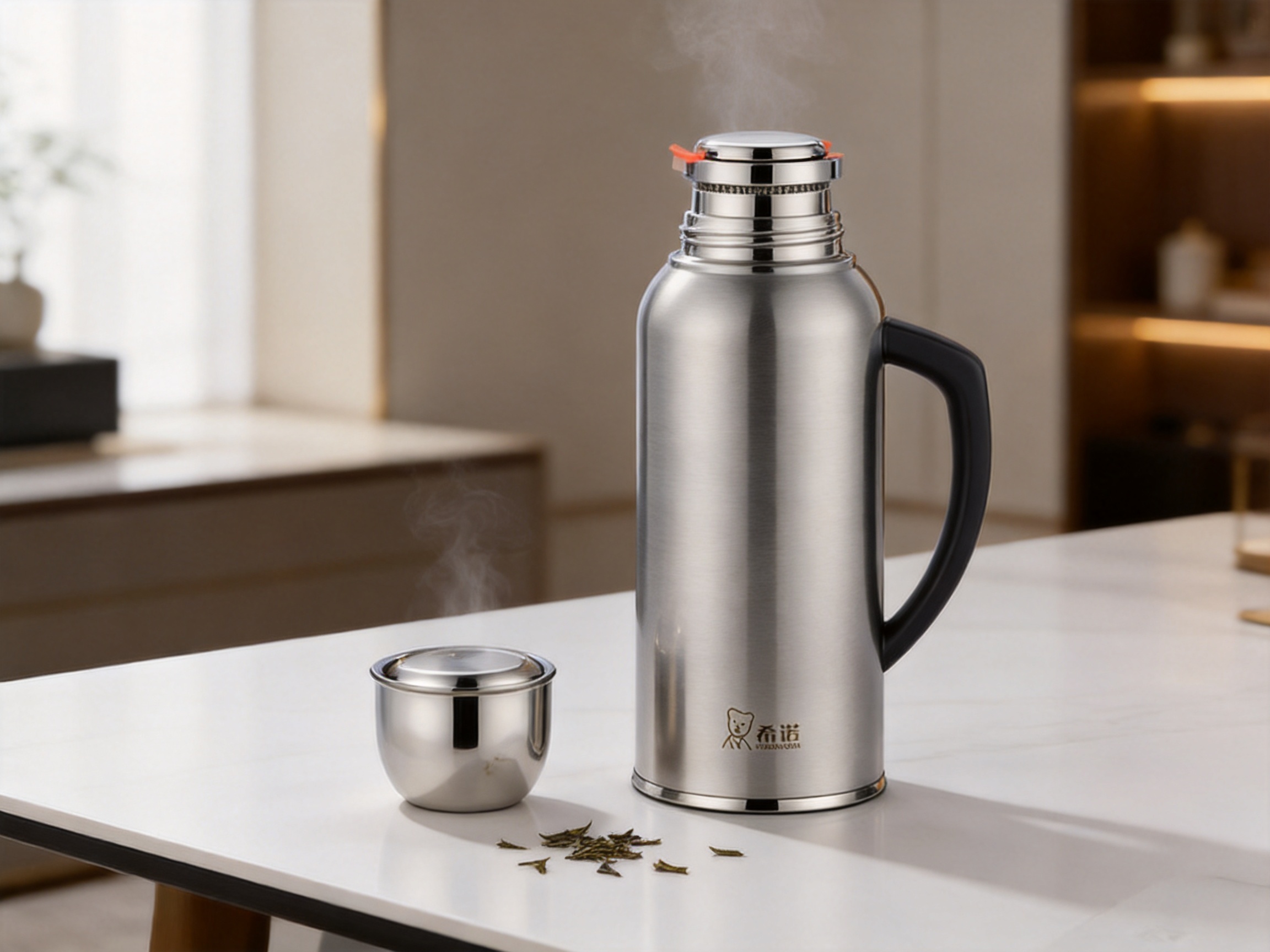
The magnetic outer lid adds a second layer of practicality. When attached to the mouth of the kettle, it helps keep dust and airborne particles away from the opening. When removed, it can be used as a small tea cup. This creates a compact two-purpose system: the kettle provides the beverage container, while the outer lid provides a convenient serving accessory.
These features make the kettle more than a standard insulated container. It is a combined steeping vessel, serving kettle, thermal storage product, and portable tea set. Its design is particularly suitable for users who value a slower tea experience but cannot always use a full traditional tea ceremony setup.
Design Philosophy: Traditional Tea Culture Adapted for Modern Life
The product draws inspiration from Eastern tea culture, especially the idea that tea preparation is not only a method of making a beverage but also a way of creating a calm, deliberate moment. Traditional tea preparation often depends on layered extraction, careful pouring, and attention to aroma, color, and mouthfeel. However, traditional equipment can require several separate pieces, a stable table, and considerable preparation time.
This kettle simplifies that experience without eliminating the essential steeping process. Users can place tea leaves or suitable ingredients into the filter, add hot water, close the lid, and allow the beverage to develop inside the vacuum-insulated vessel. The process is appropriate for a quiet morning at home, a short break in an office, or a day outdoors.
The design also supports a faster routine. A user who does not have time for multiple brewing steps can prepare tea directly in the kettle and pour it when ready. The rotating inner lid reduces the need to remove a complete cap during serving. This supports a cleaner and more controlled process while reducing the number of loose components that could be misplaced.
The magnetic outer lid reinforces this balance between ritual and convenience. It can remain attached to protect the mouth of the kettle, or it can become a small cup when the user wants to drink immediately. A separate serving cup is not essential, which helps reduce the amount of equipment required for office or outdoor use.
In this way, the kettle serves several user groups at the same time. Tea enthusiasts can use it for slow steeping and aroma development. Office workers can prepare tea in advance and pour it during the workday. Families can use the larger size for shared serving. Travelers and outdoor users can carry one container that supports both storage and drinking.
Anti-scald Home Stainless Steel Kettle
316L Stainless Steel Construction
Corrosion Resistance and Beverage Compatibility
One of the strongest advantages of the kettle is its extensive use of 316L stainless steel. The outer shell, inner liner, filter screen, and outer lid are all specified as 316L stainless steel. This grade is widely valued for its corrosion resistance, particularly in environments where moisture, heat, salts, and acidic ingredients may be present.
Tea contains naturally occurring compounds that can interact with inferior materials over time. Citrus peel, flavored tea, herbal ingredients, and other brewed products may also create demanding conditions for internal surfaces. A corrosion-resistant stainless steel construction provides a more durable base for repeated beverage preparation than materials that are more vulnerable to staining, rusting, or surface degradation.
The “L” designation refers to low carbon content, which is associated with improved resistance to certain forms of corrosion after welding and fabrication. While final performance depends on manufacturing quality, forming methods, weld control, cleaning, and finishing, 316L is a strong material choice for drinkware requiring repeated exposure to hot liquids.
Stainless steel also provides a neutral, durable contact surface. When properly processed and maintained, it is less likely to retain odors than some porous or lower-quality materials. This is important for users who alternate between green tea, black tea, citrus-infused drinks, and plain hot water.
Structural Strength
Compared with thin glass or brittle ceramic, stainless steel offers strong resistance to impact during normal handling. This makes the kettle appropriate for office kitchens, dining tables, hospitality environments, and outdoor use. The material can withstand the routine knocks and movement associated with daily transportation more effectively than many fragile alternatives.
The use of stainless steel in both the inner and outer structure also supports long-term product stability. A well-formed steel body can maintain its shape through repeated filling, pouring, washing, and transport. The durable exterior helps protect the insulation system and internal components from common handling stresses.
For procurement teams, material durability can reduce the frequency of replacement. A product that remains attractive and functional over a longer service period may contribute to lower total ownership cost, even if its initial purchase price is higher than that of a basic plastic or low-grade steel kettle.
Flavor Neutrality and User Confidence
The product description emphasizes healthy use with no off-flavors. This is especially significant for tea preparation, where aroma and taste are central to the user experience. A beverage vessel should not introduce strong plastic, metallic, or residual manufacturing odors into delicate drinks.
Material selection alone does not guarantee flavor neutrality. Surface finishing, cleaning, sealing materials, assembly conditions, and packaging also matter. However, a 316L stainless steel beverage-contact system provides a strong material foundation for achieving a clean sensory experience when combined with proper production and quality control.
Vacuum Insulation for Heat Retention
The kettle uses vacuum-insulation technology to slow heat loss. In a vacuum-insulated structure, the reduced air space between the inner and outer walls limits heat transfer through convection and conduction. The result is a container that can keep hot water or brewed tea warm for longer than a single-wall vessel.
For tea preparation, thermal retention has several advantages. The user can prepare the drink without needing to consume it immediately. Tea can be steeped and then served over a longer period, which is useful at work, during meetings, while studying, or during outdoor activities. The insulation also reduces the need for repeated reheating.
Longer heat retention can help preserve the intended drinking experience. Tea develops over time, and the ability to maintain warmth allows users to enjoy several pours without the beverage cooling too quickly. It also supports more flexible scheduling, because the kettle does not require constant attention.
The vacuum structure has practical safety benefits as well. The outer surface of an insulated kettle is generally easier to handle than the surface of a vessel containing hot liquid without insulation. The product is described as anti-scald, and its insulation and controlled lid system are intended to make hot beverage service more comfortable. Users should still handle hot liquids carefully, because insulation does not remove the risk associated with boiling water or hot tea.
Compared with ordinary brewing vessels, the kettle offers a combined thermal and steeping function. A conventional ceramic teapot may provide an excellent serving experience but usually does not offer the same level of portability or vacuum heat retention. A standard bottle may retain heat but lack a suitable filter and controlled tea-brewing mechanism. This product is designed to bridge those two categories.
Dual-Rotation Inner Lid and 360-Degree Pouring
Controlled Flow
The dual-rotation inner lid is a central functional advantage. By turning the lid to open or close the internal outlet, the user can manage the flow without fully removing the lid. This creates a more controlled serving action than simply unscrewing a cap and tipping the entire container.
The design is intended to support 360-degree outflow. The kettle can be oriented in different directions while pouring, which is valuable when the handle or spout position is not aligned with the intended cup. It also makes group serving more convenient because the user can pour toward different positions around a table.
A controlled internal mechanism can also help keep tea leaves and steeping ingredients inside the kettle. The integrated filter screen works with the lid system to separate liquid from larger particles during pouring. This is useful for loose-leaf tea and other ingredients that need to steep freely but should not enter the drinking cup.
Reduced Spill Risk
The product description highlights pouring without spillage when the lid is operated correctly. A rotating opening system can reduce sudden liquid release by giving the user greater control over the flow path. It also avoids the unstable movement that can occur when a loose lid must be held separately while pouring.
Spill resistance depends on correct assembly, seal condition, filling level, pouring angle, and the temperature of the liquid. Nevertheless, the integrated lid architecture offers a practical advantage over simple open-mouth containers. For office environments and shared tables, reducing accidental drips can help protect documents, electronic equipment, furniture, and clothing.
Easy Operation
The mechanism is designed around a simple left-and-right rotation. This can make the product easier to understand than a complicated multi-step tea brewer. The user does not need to learn a specialized brewing procedure. A light turn opens the outlet, and an opposite turn closes it.
For brands and procurement teams, simple operation is important because a product must be usable by people with different levels of familiarity. A tea expert can appreciate the controlled extraction and serving process, while a first-time user can quickly understand the basic open, pour, and close functions.
Magnetic Outer Lid as a Protective Cover and Tea Cup
The magnetic outer lid adds a distinctive multifunctional element. When installed on the mouth of the kettle, it helps protect the opening from dust and environmental particles. This is useful when the kettle is placed on a desk, kitchen counter, picnic table, or outdoor surface between uses.
When detached, the outer lid can be used directly as a small tea cup. This eliminates the need to carry a separate cup for short trips or individual serving. The magnetic attachment also makes it quick to reconnect, helping reduce the chance of losing the cover.
This two-purpose design reflects a broader movement toward compact, multifunctional products. Consumers increasingly prefer items that perform several tasks without requiring additional accessories. A kettle that includes its own serving cup can be more convenient for travel, workplace use, and outdoor activities.
The cup function also supports the intended tea experience. Users can pour a small amount, evaluate aroma and taste, and continue serving as desired. For tea drinkers who enjoy gradual consumption, this is more flexible than drinking directly from a large container.
From a manufacturing perspective, the magnetic lid requires careful attention to dimensional control, magnetic retention, surface finishing, and user safety. The attachment must be strong enough for normal handling but easy enough to remove without excessive force. The interface should also be designed to avoid sharp edges, exposed components, or unstable positioning during use.
Filter Screen and Steeping Performance
The stainless steel filter screen is designed to support loose-leaf tea and other steeping ingredients. Unlike a narrow tea bag chamber, a larger filter area can give leaves more space to open and interact with hot water. This can contribute to a fuller extraction and a more layered beverage profile.
The product description notes that ordinary brewing may not extract the full flavor of certain ingredients, while steeping allows tea polyphenols, alkaloids, and other substances to be released more completely. The exact result depends on the type of tea, water temperature, steeping duration, ingredient quantity, and personal preference. However, the kettle’s internal filter and thermal design are well suited to users who want more control over the steeping process.
Small green-tangerine peel and black tea are identified as suitable ingredients. The kettle may also be used with other compatible teas and dried botanicals, provided that the user follows appropriate preparation and cleaning practices. Ingredients that expand significantly, produce fine particles, or create strong residues should be used with care to prevent filter blockage.
The filter screen must balance two competing requirements. It should retain leaves and larger particles while allowing liquid to pass smoothly. It should also be durable enough to withstand repeated insertion, removal, washing, and exposure to hot water. Stainless steel is an appropriate material for this purpose because it offers strength, heat resistance, and corrosion resistance.
For professional buyers, the filter design can be an important differentiator. A product that supports both storage and brewing provides a more complete use case than an insulated bottle without a filter. It can also create opportunities for tea brands, hospitality suppliers, corporate gifting programs, and lifestyle retailers seeking products associated with premium beverage preparation.
Comparison with Competing Product Types
Compared with Ordinary Vacuum Bottles
A conventional vacuum bottle is primarily designed to store and transport liquids. It may retain heat effectively, but it often has a basic opening, a separate cup, or no dedicated tea filter. Users may need to brew tea elsewhere and transfer it into the bottle, which adds time and creates additional washing steps.
The Anti-Scald Home Stainless Steel Kettle is designed to combine brewing, steeping, storage, and serving. Its filter screen allows ingredients to remain in the vessel during preparation, while the rotating lid supports controlled pouring. The magnetic outer lid also provides a built-in serving cup. These features give it a broader functional range than a simple thermal bottle.
Compared with Ceramic Teapots
Ceramic teapots are valued for their appearance, traditional character, and ability to support a focused tea ritual. However, they can be fragile, less portable, and more vulnerable to rapid heat loss depending on their design. They also generally require a separate cup and may not be convenient for outdoor or workplace use.
The stainless steel kettle offers greater mobility and impact resistance. Its vacuum-insulated body supports longer heat retention, and its integrated cup reduces the number of accessories required. While it may not replace a formal ceramic tea set in every situation, it offers a more practical solution for daily use outside the home.
Compared with Glass Tea Brewers
Glass brewers allow users to observe the color and movement of tea leaves. They can create an attractive visual experience, but glass is more susceptible to breakage and may provide less insulation unless combined with a separate thermal sleeve or double-wall structure.
The stainless steel kettle prioritizes durability, heat retention, and portability. Users may not be able to see the brewing process directly, but they gain a stronger vessel for transportation and repeated use. For offices, travel, hospitality service, and outdoor activity, this trade-off can be advantageous.
Compared with Low-Cost Stainless Steel Kettles
Low-cost stainless steel kettles may use simpler grades of steel, basic screw caps, fixed pouring positions, or separate strainers. They can be functional, but they may not provide the same combination of 316L construction, integrated steeping, 360-degree pouring, and magnetic cup functionality.
The product’s competitive value comes from the integration of several features rather than from one isolated component. High-quality materials, vacuum insulation, a dual-rotation inner lid, a filter screen, and a multifunctional outer lid create a more complete system.
Manufacturing Capabilities and Industrial Strength
Experience in Drinkware Development
Heenoor Co., Ltd. was founded in 1999 and has developed extensive experience in drinkware product development and industrial manufacturing. This long operating history supports knowledge of the practical requirements involved in transforming a concept into a repeatable commercial product.
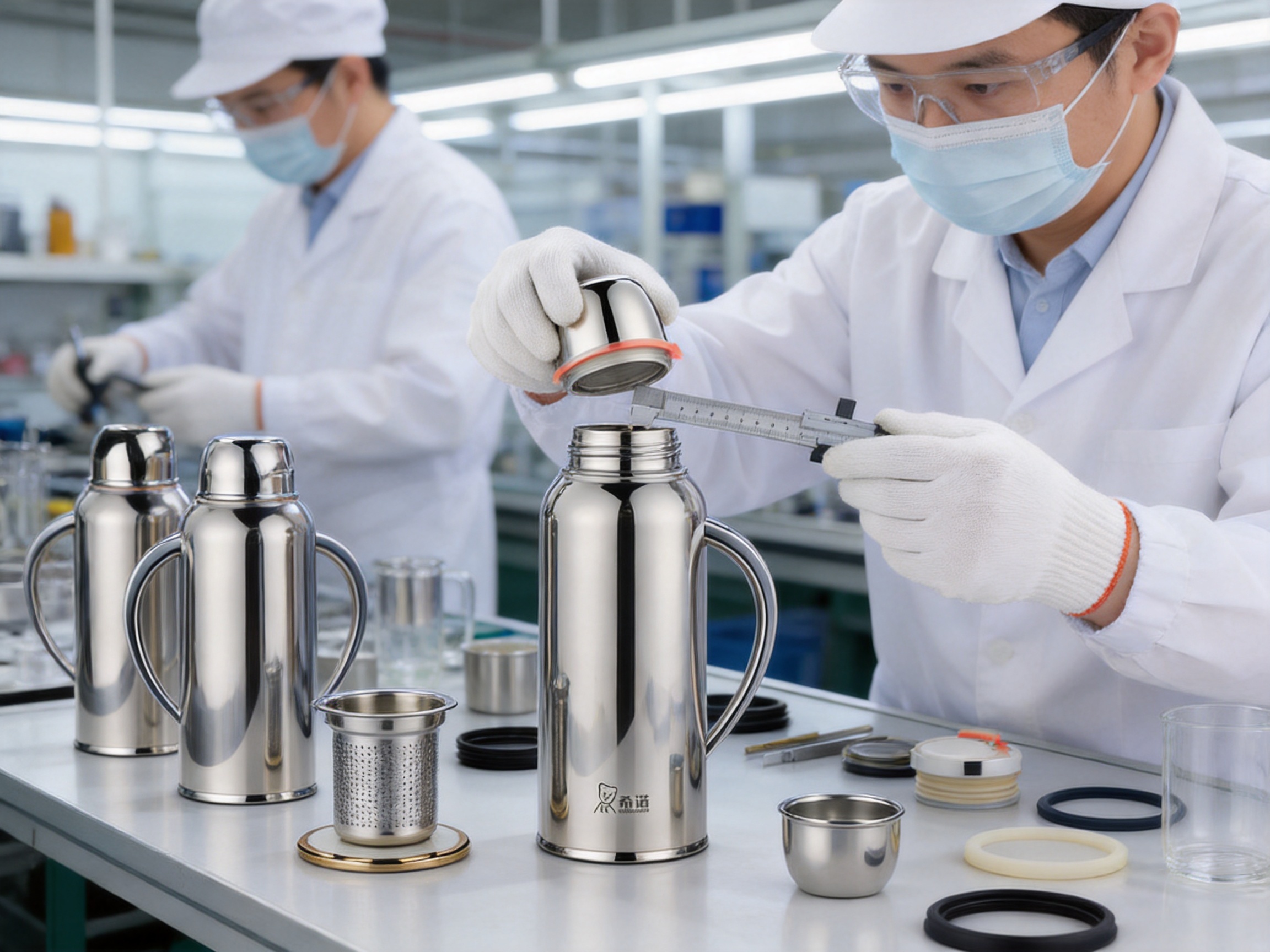
Drinkware manufacturing is not limited to forming a metal shell. A successful product requires coordination between design, material selection, tooling, welding or joining, surface treatment, assembly, sealing, inspection, packaging, and logistics. Each stage can affect thermal performance, appearance, durability, and user safety.
The company works with stainless steel, titanium, plastic, and glass drinkware. This multi-material background is valuable because modern drinkware often combines several materials in one product. The kettle itself demonstrates this approach through its stainless steel body and filter, Tritan component, silicone sealing ring, and electroplated ABS handle.
Product Design and Engineering Validation
Product design must address both appearance and performance. The kettle’s rounded portable form, integrated handle, lid architecture, and magnetic cup require the design team to consider ergonomics, assembly, cleaning, thermal behavior, and dimensional relationships at the same time.
Engineering validation helps determine whether the design can perform consistently under expected use conditions. Relevant evaluation areas may include lid operation, seal performance, thermal retention, filter fit, magnetic attachment, handle strength, surface quality, and resistance to repeated use. The specific validation program can be adjusted according to customer requirements, target market, and applicable standards.
Early engineering review is particularly important for a product with multiple moving or detachable components. The dual-rotation inner lid must operate smoothly and align correctly with the outlet. The magnetic outer lid must attach securely and remain easy to remove. The filter must fit properly without interfering with the lid or sealing ring. These relationships should be reviewed before mass production to reduce rework and improve product reliability.
Tooling Development
Tooling development has a direct effect on consistency. Stainless steel bodies, lids, filters, and related components require tools that support repeatable forming, cutting, stamping, or other manufacturing operations. Tool accuracy helps maintain uniform dimensions across production batches.
For a kettle with a multi-part lid system, tooling precision is especially important. Small dimensional variations can affect sealing, rotational movement, magnetic fit, or pouring behavior. Proper tooling development helps ensure that parts produced at different times remain compatible during assembly.
Heenoor’s integrated approach to tooling development allows design and production considerations to be addressed together. A product can be reviewed not only for visual appeal but also for manufacturability, assembly efficiency, material utilization, and long-term supply capability.
Standardized Production
Standardized production provides a framework for consistent output across larger quantities. It includes defined work instructions, controlled component specifications, inspection checkpoints, assembly procedures, and traceable quality records.
For brands and procurement teams, manufacturing consistency is essential. A product may perform well in a sample evaluation but fail to meet expectations if subsequent batches show differences in fit, finish, lid operation, or sealing performance. Standardized production helps narrow these variations and supports stable deliveries.
The kettle’s construction benefits from controlled assembly because several components interact within a compact system. The sealing ring must be positioned correctly. The filter must be installed securely. The handle must be fixed with appropriate alignment and strength. The lid components must operate smoothly after assembly. Consistent procedures help maintain the intended user experience.
Quality Management
Quality management covers more than final visual inspection. It should begin with incoming material control and continue through production, assembly, testing, packing, and shipment. For a stainless steel kettle, quality considerations may include material identification, dimensional checks, weld or joint quality where applicable, surface condition, sealing integrity, functional operation, and packaging protection.
Because the product is intended for hot liquids, functional inspection is important. A lid that looks acceptable but does not close correctly can create a poor user experience. A filter that is misaligned can affect pouring. A handle that is not securely assembled can create a handling concern. Quality management must therefore include both appearance and performance.
Heenoor positions itself as a manufacturing partner for brands, organizations, and procurement teams that value technical clarity, manufacturing discipline, and long-term supply stability. This positioning is relevant to customers seeking more than a catalog item. It suggests an ability to support product development, production planning, and ongoing program management.
Material and Component Specification
| Component or Feature | Specification | Functional Contribution |
|---|---|---|
| Outer lid | 316L stainless steel | Provides a durable protective cover and supports the multifunctional cup design. |
| Outer shell | 316L stainless steel | Provides structural protection and a durable exterior for daily use. |
| Inner liner | 316L stainless steel | Creates a corrosion-resistant beverage-contact surface. |
| Filter screen | 316L stainless steel | Supports loose-leaf tea steeping and helps retain larger particles during pouring. |
| Inner lid | 316L stainless steel and Tritan | Supports the rotating flow-control mechanism and integrated sealing structure. |
| Sealing ring | Silicone rubber | Helps support closure and liquid retention. |
| Handle | Electroplated ABS | Provides a lightweight gripping component with a finished appearance. |
| Available capacity | 0.8 liter and 1.35 liters | Offers options for personal use, shared serving, and larger-volume preparation. |
| Approximate weight | 0.65 kilogram and 0.84 kilogram | Balances substantial construction with portability. |
| Model series | XN-2033 / 2035 | Identifies the available product configurations. |
Ergonomics and Daily User Experience
A successful kettle must be comfortable to hold, fill, pour, clean, and store. The handle is therefore an important part of the overall design. Electroplated ABS can provide a shaped, lightweight grip with a finished appearance that complements the metal body. The handle should distribute the weight of the kettle comfortably, particularly when the larger 1.35-liter version is full.
The two capacity options allow users to select a size appropriate to their habits. The 0.8-liter model is suitable for a single user or a small number of servings. It may be easier to carry in an office or travel environment. The 1.35-liter model is better suited to shared use, family service, meetings, and situations where refilling would be inconvenient.
The 360-degree pouring concept improves usability for right-handed and left-handed users. It also reduces the need to rotate the entire kettle to a particular orientation. This can be useful when serving from different sides of a table or when the product is placed in a compact space.
The magnetic outer lid simplifies accessory management. A separate cup can easily be forgotten, misplaced, or damaged. By integrating the cup into the kettle, the product supports a more organized routine. The lid can be attached to the kettle during storage and used immediately when needed.
Cleaning should be performed according to the care instructions provided with the final product. Users should pay particular attention to the filter, sealing ring, inner lid, and any areas where tea residue may collect. Regular cleaning helps preserve flavor neutrality and supports reliable operation over time.
Applications Across Different Environments
Home Tea Service
At home, the kettle can support a simplified tea ritual. Users can prepare tea in the kitchen, allow it to steep, and bring the insulated kettle to a dining table or living area. The ability to serve without removing the entire lid keeps the process neat and reduces the number of objects required.
The product is also suitable for households where different people drink tea at different times. The vacuum insulation allows the beverage to remain warm for longer, reducing the need to prepare a new batch for every serving.
Office and Workplace Use
In offices, the kettle can be used in a shared pantry, meeting room, reception area, or personal workspace. The 0.8-liter version can serve an individual or a small team, while the 1.35-liter version can support group meetings and shared refreshments.
The controlled pouring mechanism is useful around documents and electronic equipment. The magnetic cup allows the user to drink without bringing a separate mug, which can be helpful in flexible work environments and shared office spaces.
Hospitality and Guest Service
Hotels, guesthouses, tea rooms, and corporate hospitality programs may use the kettle as part of a premium beverage presentation. Its stainless steel construction and coordinated lid system can create a more distinctive experience than a generic thermal flask.
For hospitality buyers, visual consistency and reliable replenishment are important. A manufacturer with experience in tooling, standardized production, and quality management can support repeat orders and consistent product presentation across multiple locations.
Outdoor Activities
The kettle can be used for picnics, camping, outdoor meetings, travel, and recreational activities. Stainless steel provides greater resistance to ordinary transport impacts than glass, while vacuum insulation supports hot beverage service away from a kitchen.
The integrated cup is particularly useful outdoors because it reduces the need for extra tableware. Users should still transport the product upright when possible and follow safe handling practices for hot liquids.
Customization and Private-Label Opportunities
Drinkware products are often used as brand-building tools, promotional gifts, hospitality accessories, or retail merchandise. The kettle’s design provides several potential points for customization, subject to engineering review and production feasibility.
Customers may consider customized colors, surface finishes, handle treatments, packaging, logos, instruction materials, or gift-set configurations. The exact options depend on order volume, target market, component compatibility, and required production schedule.
Customization should not compromise the product’s core functions. Any change to the outer surface should be evaluated for durability and resistance to handling. Any modification to the lid or handle should be reviewed for fit and ergonomics. Packaging should protect the metal surfaces, magnetic lid, filter, and rotating mechanism during transportation.
Heenoor’s experience in product design, engineering validation, tooling development, and standardized manufacturing can help customers evaluate these decisions. The goal is to create a product that is visually aligned with a brand while retaining reliable function and scalable production.
Procurement Considerations for Buyers
Professional buyers should evaluate the kettle across several dimensions rather than focusing only on nominal capacity or appearance. Material specifications, component construction, insulation performance, lid operation, filter design, packaging, order quantity, quality procedures, and after-sales support all contribute to the value of the program.
Buyers should confirm which components contact beverages and whether the selected materials match the intended market requirements. They should also review the sealing ring material, handle construction, and care instructions. For international programs, documentation and labeling may need to be adapted to the destination market.
Sample approval is an important stage. A sample should be evaluated for pouring comfort, lid movement, magnetic attachment, cup stability, filter fit, surface finish, handle strength, and cleaning access. It is also useful to test the product with different tea types and realistic filling levels.
Production planning should include lead time for material preparation, tooling, pilot production, inspection, packaging, and shipment. When customized finishes or logos are required, additional approval steps may be necessary. Early communication between the buyer and manufacturer can reduce delays and prevent misunderstandings.
Long-term supply stability is another important consideration. A manufacturer that combines product development and industrial production may be better positioned to support design updates, replacement components, repeat orders, and future product extensions.
Care, Maintenance, and Responsible Use
Users should inspect the kettle before each use, especially if it has been dropped or subjected to unusual impact. The lid should be properly closed before transport, and hot liquids should be handled carefully. The product should not be overfilled because sufficient space may be needed for safe closure and pressure management.
The filter, inner lid, and sealing ring should be cleaned regularly. Tea residues can affect flavor and may interfere with the movement of the lid if allowed to accumulate. Mild cleaning methods are generally preferable to abrasive tools that could scratch surfaces or damage seals.
Users should follow the manufacturer’s specific instructions regarding dishwasher use, cleaning agents, temperature limits, and disassembly. Components should be dried appropriately after cleaning, particularly when the product will be stored for an extended period.
The magnetic outer lid should be kept clean so that the attachment remains smooth and stable. The handle should be checked periodically for looseness or damage. If any component no longer functions correctly, the product should be removed from service until it has been inspected or repaired according to the manufacturer’s guidance.
Frequently Asked Questions
What is the main purpose of this kettle?
The kettle is designed for hot water storage, loose-leaf tea steeping, controlled pouring, and convenient serving. It combines the functions of an insulated flask, tea brewer, and compact serving set.
What materials are used in the main body?
The outer shell, inner liner, filter screen, and outer lid are made from 316L stainless steel. The inner lid combines 316L stainless steel with Tritan. The sealing ring is silicone rubber, and the handle is electroplated ABS.
What capacities are available?
The available capacities are 0.8 liter and 1.35 liters. The smaller size is suitable for personal or small-group use, while the larger size is appropriate for family service, meetings, and shared beverages.
How does the dual-rotation inner lid work?
The inner lid is designed to open and close through rotation. Turning it in one direction opens the flow path for pouring, while turning it in the opposite direction closes the flow path. The mechanism is designed to support 360-degree pouring.
Can the outer lid be used as a cup?
Yes. The magnetic outer lid can attach to the mouth of the kettle as a protective cover and can be removed for use as a small tea cup.
Is the product suitable for loose-leaf tea?
Yes. The integrated stainless steel filter screen is intended to support loose-leaf tea and other suitable steeping ingredients. Small green-tangerine peel and black tea are specifically identified as suitable examples.
Why is 316L stainless steel advantageous?
316L stainless steel is valued for corrosion resistance, durability, and suitability for demanding beverage-contact applications. It provides a strong material foundation for repeated use with hot water, tea, and compatible flavored ingredients.
Does vacuum insulation keep tea hot indefinitely?
No. Vacuum insulation slows heat loss but does not maintain temperature indefinitely. Actual thermal performance depends on the starting temperature, filling level, ambient conditions, lid position, and usage pattern.
Is the kettle completely spill-proof?
The rotating lid and sealing system are designed to support controlled pouring and reduce the risk of spills when used correctly. However, no hot-liquid container should be considered completely spill-proof. Users should close the lid properly and handle hot beverages with care.
Can the kettle be customized?
Potential customization may include finishes, colors, logos, packaging, and other details, depending on engineering feasibility, order quantity, and production requirements. Customization should be discussed with the manufacturer before project confirmation.
Who can benefit from this product?
Home tea drinkers, office users, hospitality operators, corporate gift buyers, outdoor enthusiasts, retailers, and organizations seeking a premium multifunctional drinkware product may all find the kettle suitable.
What should buyers evaluate before placing an order?
Buyers should evaluate material specifications, sample performance, lid operation, filter fit, thermal requirements, surface finish, packaging, quality control, customization options, production capacity, and long-term supply support.
Conclusion
The Anti-Scald Home Stainless Steel Kettle offers a distinctive combination of traditional tea preparation and modern drinkware convenience. Its 316L stainless steel body and filter provide a durable, corrosion-resistant foundation. Vacuum insulation helps slow heat loss, while the dual-rotation inner lid supports controlled, 360-degree pouring. The magnetic outer lid adds further value by functioning as both a protective cover and a small tea cup.
These features give the kettle a broader range of applications than a standard vacuum bottle, ceramic teapot, glass brewer, or basic stainless steel flask. It can support relaxed home tea preparation, efficient office use, hospitality service, travel, and outdoor drinking with one integrated product.
The product’s value also depends on the manufacturing system behind it. Heenoor Co., Ltd. brings experience in stainless steel, titanium, plastic, and glass drinkware, supported by product design, engineering validation, tooling development, standardized production, and quality management. This integrated capability is important for a product whose performance depends on the precise interaction of multiple materials and moving components.
For brands, distributors, procurement teams, and organizations seeking dependable drinkware programs, the kettle represents a practical balance of function, durability, portability, and cultural appeal. It is not simply a container for hot water. It is a compact tea-brewing and serving system designed for the way people live and work today.
References
1. Product specification materials for the Anti-Scald Home Stainless Steel Kettle, model series XN-2033 / 2035.
2. General technical literature on 316L stainless steel for corrosion-resistant beverage-contact applications.
3. General engineering references on vacuum insulation and heat-transfer reduction in double-wall drinkware.
4. General design references on ergonomic handles, controlled-pour lids, and multifunctional portable drinkware.
5. General tea preparation references concerning steeping time, water temperature, extraction, and loose-leaf tea service.
6. Manufacturing information supplied for Heenoor Co., Ltd., including product development, engineering validation, tooling development, standardized production, and quality management capabilities.
Product: Anti-scald Home Stainless Steel Kettle

You may also like…
Copyright © 2025 Heenoor Co., Ltd. All Rights Reserved.
 Custom Stainless Steel Drinkware Manufacturers
BACK TOP