 English
 中文简体
中文简体 日本語
日本語 Español
 عربى
عربى
Search
Categories
Recommend
Categories
 Lin Yuxi — International Product Sales Manager
Recommend
-
 Industry news
 -
 Industry news
 -
 Industry news
 -
 Industry news
Sep 20, 2026 - By admin
Double-Layer Antibacterial Goose Egg Glass: A Compact Titanium and High-Borosilicate Drinkware Solution
Content
- 1 Product Concept and Everyday Application
- 2 Material Architecture: Glass, Titanium, Silicone, and PP
- 3 Silver Ion Mist Coating and Antibacterial Design
- 4 Thermal Performance and Beverage Visibility
- 5 Leak-Reducing Lid and Filter Function
- 6 Advantages Compared with Common Drinkware Alternatives
- 7 Engineering and Manufacturing Strengths
- 8 Production Considerations for a Multi-Material Cup
- 9 Capacity Options and Market Positioning
- 10 For Brands, Distributors, and Procurement Teams
- 11 Use, Care, and Product Longevity
- 12 Why the Product Is Suitable for Premium Gifting
- 13 Frequently Asked Questions
- 13.1 What is the body of the cup made from?
- 13.2 Which components are made from pure titanium?
- 13.3 What is the purpose of the silver ion mist coating?
- 13.4 Can the cup be used for hot beverages?
- 13.5 Does the lid help prevent leaks?
- 13.6 Is a filter included?
- 13.7 What capacities are available?
- 13.8 Is the cup suitable for vehicle use?
- 13.9 What is the approximate weight?
- 13.10 How does it compare with a regular stainless steel bottle?
- 13.11 Is the product suitable for business gifts?
- 13.12 Can the product be customized?
- 13.13 Does the antibacterial coating eliminate the need for washing?
- 14 Conclusion
- 15 References
- 16 Product: Double-Layer Antibacterial Goose Egg Glass
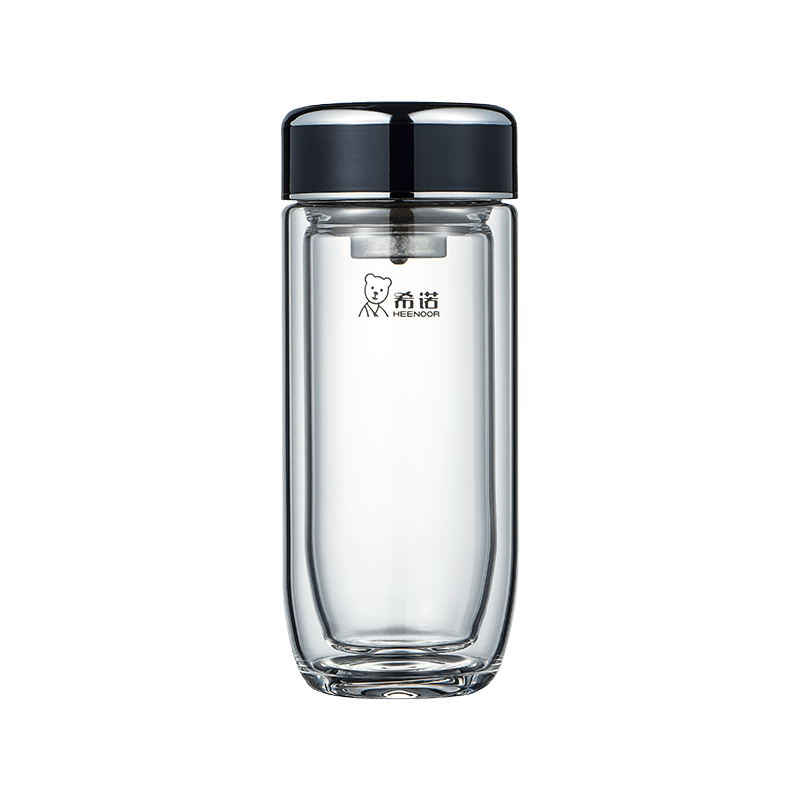
Modern drinkware must do more than hold water. For commuters, office workers, travelers, and outdoor users, a practical cup should be safe for daily contact, comfortable to use, easy to clean, resistant to temperature changes, and compatible with the environments in which people actually live and work. The Double-Layer Antibacterial Goose Egg Glass is designed around these expectations. It combines a high-borosilicate glass body, pure titanium components, a silver ion mist coating, a leak-resistant lid, and a compact shape suited to vehicle cup holders.
This product is positioned as a premium glass water bottle rather than a simple disposable beverage container. Its design addresses several common concerns associated with everyday drinkware, including material stability, odor retention, corrosion, leakage, visual inspection of beverages, and portability. The combination of glass and titanium gives the product a distinctive material profile. The glass body offers clarity and a clean taste experience, while titanium is used in the lid water-contact surface and filter to provide corrosion resistance and chemical stability.
The product is available in 210 ml, 250 ml, and 280 ml capacities. These sizes are intended for users who prefer a compact drinkware format for tea, water, functional beverages, or other daily refreshments. The dimensions are designed to fit most vehicle cup holders, supporting commuting and in-car use without sacrificing the qualities associated with a premium glass cup.
Behind the product is Heenoor Co., Ltd., a drinkware manufacturer founded in 1999. The company integrates product design, engineering validation, tooling development, standardized production, and quality management. Its experience covers stainless steel, titanium, plastic, and glass drinkware, allowing it to support different material requirements and application scenarios. This manufacturing background is important for products that combine several materials and require reliable coordination between glass, metal, polymers, seals, and filtration components.
Double-Layer Antibacterial Goose Egg Glass
Product Concept and Everyday Application
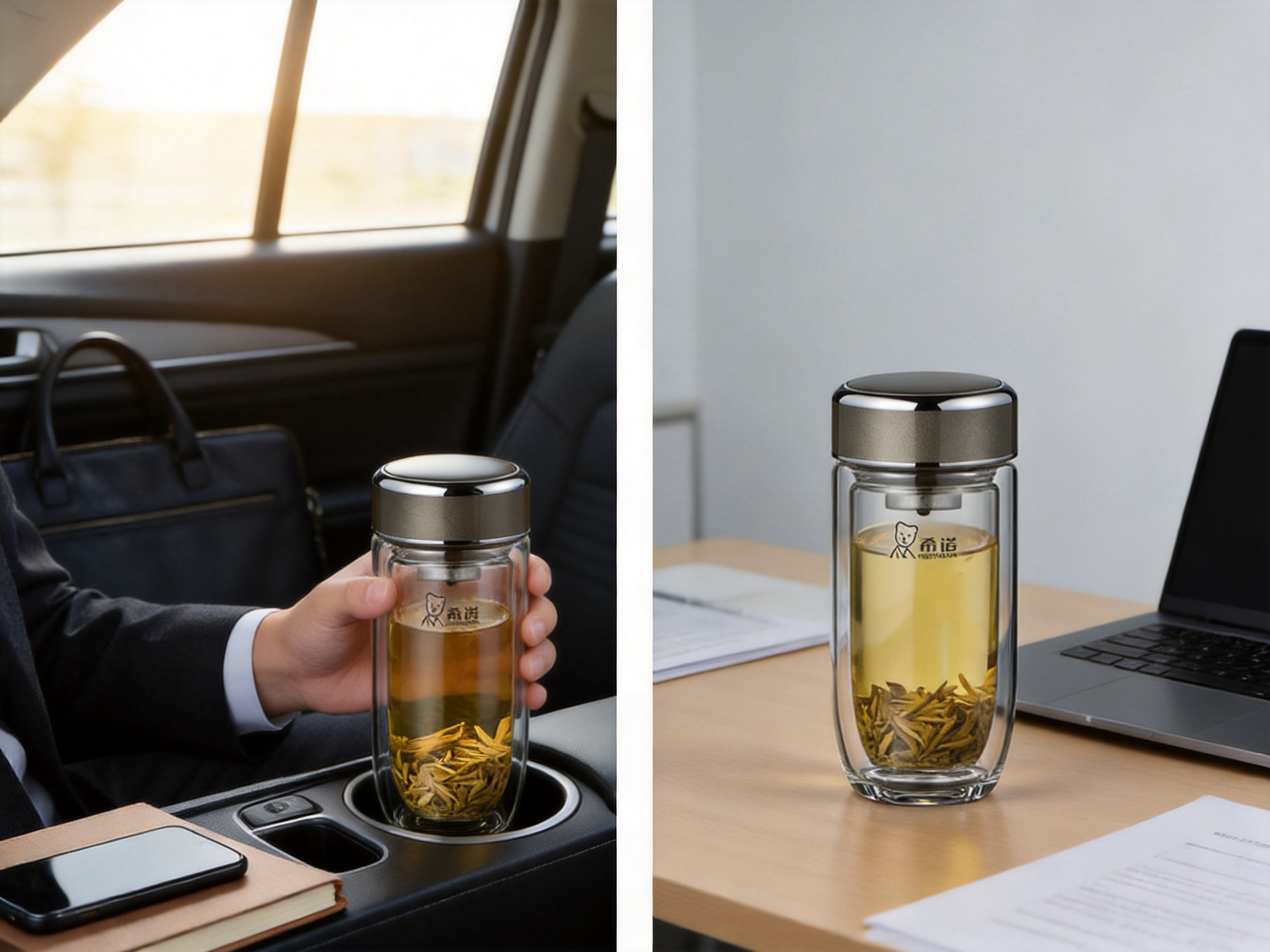
The Double-Layer Antibacterial Goose Egg Glass is developed for people who want a compact beverage container with a refined appearance and a more carefully considered material system. It can be used in offices, cars, during commuting, on business trips, and in outdoor situations where a portable cup is more convenient than a large bottle.
Its name reflects the rounded, curved shape of the body. Rather than using a completely cylindrical profile, the cup has an ergonomic contour that is intended to feel secure in the hand. The curved design also supports stable placement on a desk or other flat surface. The overall silhouette is compact and visually distinctive while remaining practical for everyday handling.
The cup is especially suitable for tea drinkers. Because high-borosilicate glass is transparent, users can observe the color and clarity of tea while it brews or is served. This is a useful advantage over opaque drinkware, particularly for green tea, flower tea, fruit tea, herbal infusions, and other beverages where appearance is part of the drinking experience.
The cup is also designed for controlled drinking. A rounded mouth provides a smoother contact point for the lips, while the filter helps separate loose tea leaves or other ingredients from the beverage. When the lid is closed, the silicone sealing ring helps reduce leakage if the cup is inverted. This combination makes the product more suitable for bags, vehicles, and workspaces than an open glass cup.
The compact capacity range is a deliberate design choice. A 210 ml cup can suit concentrated tea servings, espresso-based drinks, or short hydration periods. The 250 ml version offers a balanced everyday capacity, while the 280 ml version provides additional volume without becoming oversized for most car cup holders. Offering several sizes allows brands, distributors, and end users to select the most appropriate configuration for different markets and usage habits.
Material Architecture: Glass, Titanium, Silicone, and PP
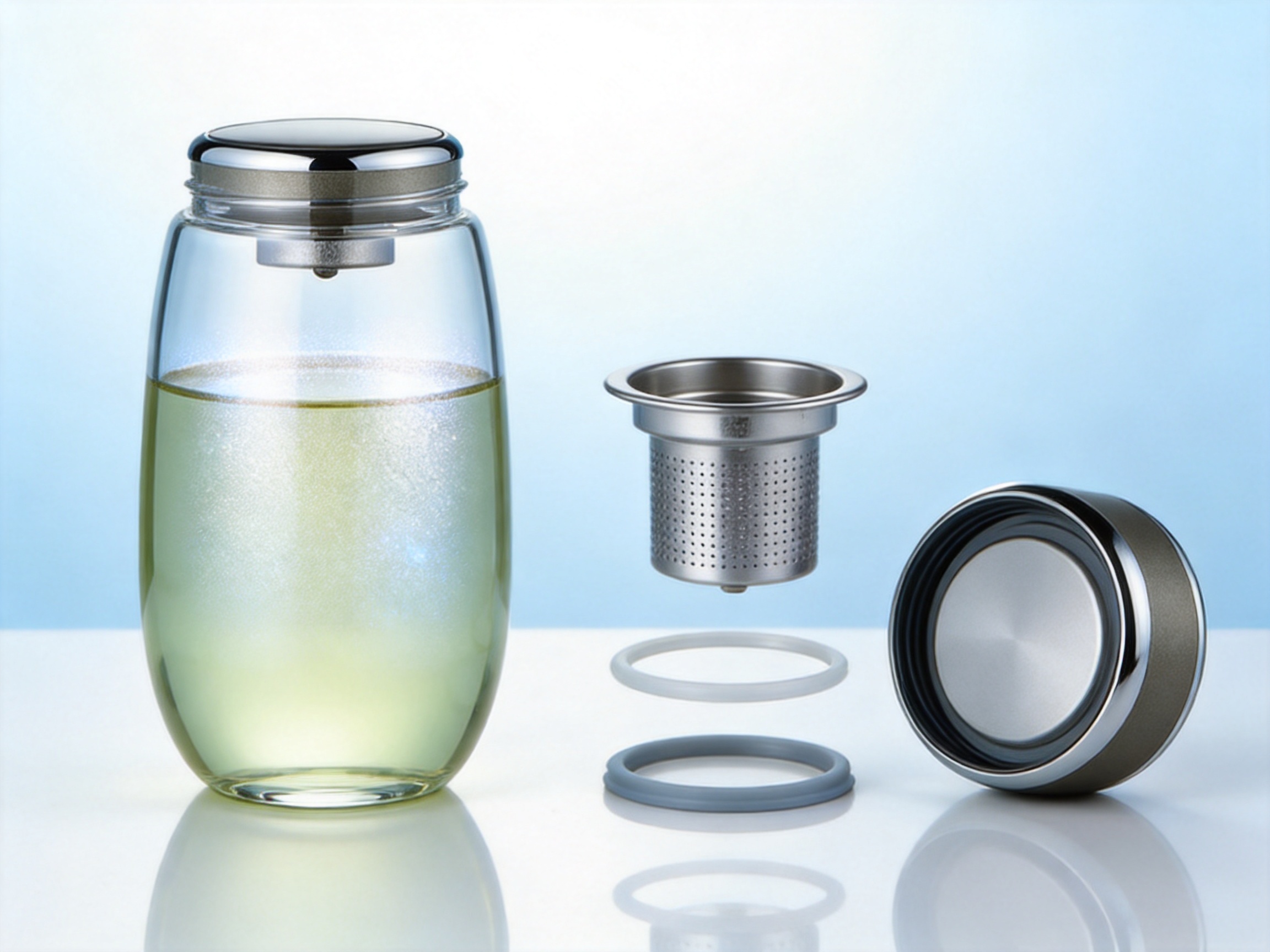
The performance of a drinkware product is strongly influenced by the compatibility of its materials. The Double-Layer Antibacterial Goose Egg Glass uses different materials where their properties are most useful. High-borosilicate glass forms the cup body. Pure titanium is used for important water-contact areas of the lid and for the filter screen. Heat-resistant silicone rubber supports the filter and sealing functions. Polypropylene, or PP, is used in the lid assembly.
High-Borosilicate Glass Cup Body
High-borosilicate glass is selected for its clarity and resistance to sudden temperature changes. This type of glass is widely valued in drinkware because it provides a clean, transparent surface and can better tolerate thermal variation than ordinary glass. For users who pour hot tea or warm water into a compact cup, thermal resistance is an important practical consideration.
The transparent body enables direct visual inspection. Users can see the beverage level, tea color, sediment, fruit pieces, and infusion strength without opening the lid. This helps make the product easier to use and more attractive for tea service. It also supports a sense of cleanliness because the interior can be visually checked before and after use.
Glass does not contribute the metallic taste that some users associate with certain metal containers. It also does not easily retain the aroma of previously stored beverages when cleaned appropriately. For people who alternate between plain water, tea, coffee, and flavored drinks, this can be a meaningful advantage.
Pure Titanium in Water-Contact Components
Pure titanium is used in the water-contact surface of the lid and in the filter screen. Titanium is known for its biocompatibility, corrosion resistance, and chemical stability. These characteristics make it suitable for applications in which the material comes into contact with beverages over extended periods.
The use of titanium distinguishes this product from drinkware that relies exclusively on conventional stainless steel components. Stainless steel remains a widely used and practical drinkware material, but titanium can offer a different balance of lightness, corrosion resistance, and chemical stability. In this product, titanium is not used as a marketing decoration alone; it is integrated into functional areas where contact with water and hot beverages is expected.
The lid specification combines pure titanium with PP. This mixed-material construction allows the lid to use titanium where water-contact performance is important while using polypropylene in supporting structural areas. Such material allocation can help balance performance, weight, manufacturability, and cost.
Heat-Resistant Silicone Rubber
Heat-resistant silicone rubber is used with the filter screen and as the sealing ring in the lid. Silicone provides flexibility and resilience, which are important for creating a dependable seal between rigid components. It also helps the filter maintain a stable position inside the lid.
The silicone ring is designed to reduce leakage when the cup is inverted. This feature is particularly relevant for users who carry the cup in a work bag or place it in a vehicle. No portable cup should be assumed to be completely leak-proof under every possible condition, but a properly designed sealing ring can significantly improve protection compared with an unsealed glass cup.
In the filter assembly, heat-resistant silicone helps maintain the shape and position of the filter during exposure to hot beverages. A protective ring around the filter edge helps prevent the filter from directly scratching the glass wall. This detail reflects attention to the interaction between rigid glass and metal components.
Polypropylene Lid Structure
Polypropylene is included in the lid specification as a supporting material. PP is commonly used in drinkware components because it is lightweight and suitable for molded parts. In this product, it works together with the titanium element and silicone sealing ring to form a practical lid assembly.
The combined use of titanium, PP, and silicone illustrates the importance of component-level engineering. A drinkware lid must provide structural integrity, comfortable handling, sealing performance, and compatibility with repeated opening and closing. Selecting one material for every part is not always the best approach. A multi-material assembly can provide a more balanced result when each material is assigned to the function it serves best.
Silver Ion Mist Coating and Antibacterial Design
The inner wall of the glass is treated with a silver ion mist coating. According to the product specification, this process fixes silver ions onto the glass surface at high temperature. The purpose is to provide ongoing antibacterial protection on the treated surface.
This feature gives the product a point of differentiation from ordinary glass cups. Conventional glass offers a clean and stable drinking surface, but this product adds a surface treatment intended to support hygiene during daily use. The antibacterial design is particularly relevant for a portable cup that may be used repeatedly throughout the day.
The silver ion coating should be understood as part of a complete hygiene system rather than a replacement for washing. Users should still empty the cup after use, rinse it promptly, clean the lid and filter, and allow all components to dry. Surface treatments can support cleanliness, but no coating eliminates the need for normal cleaning and responsible beverage storage.
The high-temperature fixing process is also significant from a manufacturing perspective. A surface treatment intended for repeated use must be applied in a controlled and consistent manner. The coating process must be coordinated with the glass material, temperature exposure, dimensional tolerances, and final assembly. This is one reason why drinkware manufacturing requires more than simple component sourcing.
Compared with products that rely only on an untreated interior, the silver ion mist coating gives the Double-Layer Antibacterial Goose Egg Glass an additional functional layer. For distributors and private-label brands, this feature can support product positioning in premium, health-conscious, tea-oriented, and business-gift markets. Any market-specific antibacterial performance statements should be supported by appropriate testing and documentation before being used in formal advertising.
Thermal Performance and Beverage Visibility
High-borosilicate glass is well suited to users who enjoy both warm and cool beverages. Its resistance to sudden temperature changes helps reduce the risk associated with abrupt thermal transitions compared with ordinary glass. Nevertheless, glass remains a breakable material, and users should avoid extreme temperature shock, direct flame, impact, or sudden contact between very hot glass and a cold surface.
The transparent design creates a direct connection between the user and the beverage. In tea preparation, color is often an indicator of brewing progress. A transparent cup makes it easy to identify whether the drink is lightly infused, fully brewed, or ready to serve. The same visibility can help users monitor the amount of liquid remaining and determine when the cup requires cleaning.
Visual clarity is also valuable in professional and hospitality settings. A compact glass cup can be used for demonstrations, tasting sessions, tea service, meeting rooms, and executive offices. The curved body and titanium details provide a more premium appearance than a basic promotional tumbler, while the small capacity helps control serving size.
For product buyers, the glass body presents a clear design opportunity. Brands can position the cup as a tea accessory, a compact office bottle, a car travel cup, a business gift, or a premium daily-use item. The same basic product platform can support several market narratives without changing its essential material structure.
Leak-Reducing Lid and Filter Function
A portable glass cup must address the practical problems created by mobility. An open glass cup may be acceptable on a dining table, but it is less suitable for a moving vehicle, a crowded desk, or a travel bag. The Double-Layer Antibacterial Goose Egg Glass therefore uses a lid with a silicone sealing ring.
The sealing ring is designed to prevent leakage when the cup is inverted. This improves confidence during short-distance transport and in-car use. The lid should be closed correctly, and users should inspect the seal regularly for contamination, displacement, or wear. Proper cleaning and assembly are important to maintaining sealing performance.
The filter screen is made from pure titanium combined with heat-resistant silicone rubber. Its purpose is to separate tea leaves or other beverage ingredients while allowing liquid to pass through. The titanium construction supports corrosion resistance and a stable structure, while the silicone component helps protect the glass wall and maintain the filter’s position.
A protective ring around the edge of the filter is a small but meaningful design element. Direct contact between a rigid filter and a glass wall can create scratching or localized impact during use. The protective ring helps reduce this contact and contributes to a smoother interaction between the filter and the cup body.
The rounded cup mouth supports comfortable drinking. A well-finished rim is especially important for glass drinkware because users directly contact it with their lips. The smooth, rounded edge helps the product feel refined and can improve the experience of drinking directly from the cup.
Advantages Compared with Common Drinkware Alternatives
The Double-Layer Antibacterial Goose Egg Glass competes with several categories of drinkware, including ordinary glass cups, stainless steel bottles, plastic tumblers, and larger vacuum flasks. Its advantages are not based on one material alone. Instead, they come from the way the product combines transparency, titanium components, compact sizing, antibacterial surface treatment, and portability.
Compared with Ordinary Glass Cups
An ordinary glass cup may provide clarity but often lacks a secure lid, integrated filter, or transport-oriented design. It may be suitable for a desk or dining table but less convenient in a car or bag. The Double-Layer Antibacterial Goose Egg Glass adds a lid, sealing ring, and filter, making it better adapted to movement.
The silver ion mist coating is another distinction. While regular glass can be cleaned effectively, this product includes a surface treatment intended to provide ongoing antibacterial support. The pure titanium water-contact components also create a more specialized material profile than a basic glass cup with a standard plastic lid.
Compared with Stainless Steel Drinkware
Stainless steel is valued for durability and portability, but it is opaque. Users cannot see the beverage level or tea color without opening the lid. The glass body of this product provides an immediate visual advantage for tea drinkers and consumers who prefer to inspect their beverages.
Some beverages can also retain aroma in certain containers if they are not cleaned thoroughly. Glass is generally appreciated for its neutral, easy-to-observe interior. The titanium components further support a premium alternative to conventional stainless steel contact parts.
Stainless steel drinkware may be preferable when maximum impact resistance or extended thermal insulation is the primary concern. The Double-Layer Antibacterial Goose Egg Glass is instead aimed at users who prioritize transparency, material stability, compact serving size, and tea enjoyment alongside portability.
Compared with Plastic Drinkware
Plastic drinkware is often lightweight and economical, but some users prefer glass for its clarity, rigid surface, and neutral sensory qualities. The high-borosilicate glass body offers a more premium presentation, while the titanium lid and filter create a durable, corrosion-resistant contact system.
Plastic can be highly functional, especially in sports and outdoor products. However, the Double-Layer Antibacterial Goose Egg Glass is designed for a different segment: office use, business travel, tea service, commuting, and premium gifting. Its materials and appearance support a more refined product identity.
Compared with Large Vacuum Flasks
Large vacuum flasks are useful for extended hydration and temperature retention, but they can be too large for short meetings, compact car interiors, or controlled tea servings. The 210 ml, 250 ml, and 280 ml capacities offer a more focused alternative.
This product is not intended to replace every large-capacity insulated bottle. Its value lies in compact convenience, beverage visibility, and a tea-friendly filter system. Buyers can select it when a smaller, more elegant drinkware format is more appropriate than a high-volume flask.
| Feature | Double-Layer Antibacterial Goose Egg Glass | Ordinary Glass Cup | Stainless Steel Bottle | Plastic Tumbler |
|---|---|---|---|---|
| Body material | High-borosilicate glass | Common glass or glass variant | Stainless steel | Plastic polymer |
| Visibility | Transparent beverage visibility | Usually transparent | Opaque | Varies by model |
| Water-contact lid component | Pure titanium with PP support | Usually plastic or basic metal | Metal or polymer | Usually polymer |
| Filter | Pure titanium with heat-resistant silicone | Often not included | Varies by model | Varies by model |
| Surface treatment | Silver ion mist coating on the inner glass wall | Usually untreated | Varies by model | Varies by material |
| Typical application | Tea, commuting, office, car use, gifting | Tabletop use | Travel and high-volume hydration | Lightweight daily use |
| Available capacities | 210 ml, 250 ml, and 280 ml | Varies | Usually broader capacity range | Varies |
Engineering and Manufacturing Strengths
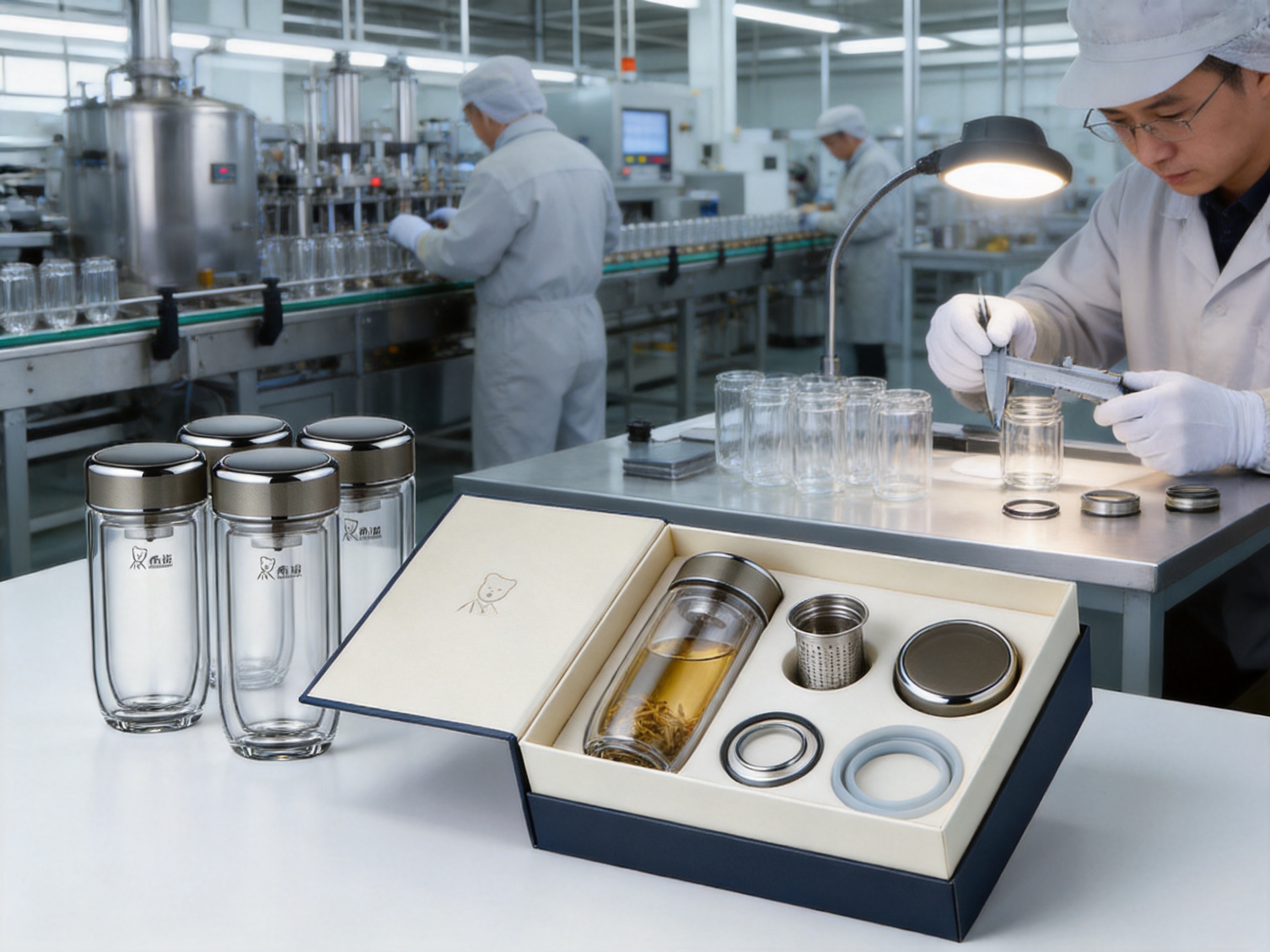
The performance of a multi-material drinkware product depends on controlled manufacturing at every stage. Heenoor Co., Ltd. has developed its business around product development and industrial manufacturing since 1999. The company integrates product design, engineering validation, tooling development, standardized production, and quality management.
Product Design and Application Planning
Product design begins with understanding the intended use. In this case, the design must balance the needs of car compatibility, glass transparency, comfortable handling, tea filtration, sealing, and compact capacity. The curved body, rounded mouth, titanium filter, and lid system are not isolated features. They form one user-oriented design concept.
Design work also involves considering the relationship between visual appearance and production requirements. A curved glass body must be shaped consistently. The lid must align with the cup opening. The sealing ring must fit within its intended interface. The filter must sit securely without damaging the glass. Each detail must be considered during development rather than added after production begins.
Engineering Validation
Engineering validation helps confirm whether a design works as intended before standardized production. For this product, validation may involve checking component fit, lid alignment, filter stability, sealing behavior, thermal exposure, surface finish, and handling comfort. The supplied product information identifies engineering validation as part of the company’s integrated manufacturing approach.
Validation is particularly important when a product combines high-borosilicate glass with titanium, PP, and silicone. These materials have different physical characteristics and manufacturing behaviors. Glass is rigid and brittle, metal is strong and dimensionally stable, PP is molded and lightweight, and silicone is flexible. Successful assembly requires appropriate tolerances and controlled interfaces.
Tooling Development
Tooling development supports repeatable production. Molds, forming tools, fixtures, and assembly aids influence the consistency of the final product. For a curved cup, tooling helps maintain the intended profile and supports repeatable dimensions. For the lid and filter, tooling contributes to accurate shaping and component compatibility.
Tooling also supports production efficiency. Once a design has been validated, dedicated tooling can help reduce variation between batches and improve assembly repeatability. This is important for buyers who require consistent products for retail programs, corporate gifts, hospitality applications, or private-label projects.
Standardized Production
Standardized production is essential when different components must work together over the product lifecycle. The glass body, lid, filter, sealing ring, and protective ring must be produced and assembled according to defined requirements. Standardization helps reduce avoidable differences between units and provides a more dependable basis for inspection.
The company’s experience with stainless steel, titanium, plastic, and glass drinkware gives it a broader material foundation than a manufacturer focused on only one category. This cross-material experience is valuable for products such as the Double-Layer Antibacterial Goose Egg Glass, where the final product is not made from glass alone.
Quality Management
Quality management links design intent to delivered product performance. It can include incoming material control, process monitoring, component inspection, assembly checks, appearance review, and final product evaluation. The exact inspection plan may vary according to customer requirements and applicable market standards.
For this product category, quality priorities may include glass clarity, body integrity, dimensional consistency, lid fit, sealing ring placement, filter alignment, titanium component finish, silicone condition, coating consistency, and packaging protection. A gift-ready product also requires attention to presentation and resistance to damage during handling and transport.
Quality management is especially important for export programs. International buyers often need clear specifications, repeatable production, reliable communication, and stable supply coordination. Heenoor positions itself as a manufacturing partner for brands, organizations, and procurement teams that value technical clarity, manufacturing discipline, and long-term supply stability.
Production Considerations for a Multi-Material Cup
Glass drinkware production requires careful control because the body must meet both aesthetic and functional expectations. The cup should have a clear appearance, a smooth mouth, an appropriate curved profile, and compatibility with the lid and filter. Visual defects, dimensional variation, or rough edges can affect user confidence even when the cup remains functional.
The high-borosilicate material must be processed in a way that preserves clarity and supports resistance to sudden temperature changes. Cooling and handling are important because uncontrolled thermal stress can affect glass integrity. The exact manufacturing parameters depend on the production equipment, design, and process controls.
The silver ion mist coating adds another production stage. The inner glass wall must be prepared, treated, and processed under controlled conditions so the coating is placed where intended. The treatment must be compatible with the product’s cleaning and use requirements. Consistency is important because uneven surface treatment could affect both appearance and performance.
Titanium components require their own manufacturing and inspection considerations. The lid water-contact surface and filter screen must achieve the intended geometry and finish. The filter’s protective ring must be fitted correctly so it can protect the glass wall without obstructing beverage flow. The titanium components must also work smoothly with silicone and PP parts.
Silicone sealing components require attention to dimensions, elasticity, surface condition, and assembly position. A sealing ring that is too loose, too tight, damaged, or incorrectly installed may reduce leakage protection. For this reason, assembly inspection is a necessary part of a complete manufacturing process.
Finally, packaging must protect the glass body and accessories during storage and transportation. The product is supplied in an elegant gift box, which supports business travel, corporate gifting, and premium retail presentation. Packaging must balance appearance with physical protection because the glass body is more vulnerable to impact than many metal or plastic alternatives.
Capacity Options and Market Positioning
The three available capacities provide flexibility for different consumer preferences and commercial applications. The 210 ml model is the most compact option. It can be positioned for concentrated beverages, tea tasting, short meetings, and users who prefer a small serving size.
The 250 ml model offers a middle capacity that may appeal to general daily use. It is suitable for office desks, commuter routines, in-car beverages, and personal tea preparation. This size can serve as a balanced option for distributors who want one configuration with broad application appeal.
The 280 ml model provides additional volume while retaining the compact design. It may be preferred by users who want a slightly longer drinking interval or a larger serving without moving to a full-size bottle.
| Model | Capacity | Approximate Weight | Suggested Positioning |
|---|---|---|---|
| XN-1915 | 210 ml | 0.38 kg | Compact tea serving, short meetings, premium gifting |
| XN-1916 | 250 ml | 0.41 kg | Balanced daily use, office, commuting, in-car use |
| XN-1917 | 280 ml | 0.42 kg | Larger compact serving, travel, extended daily use |
All three capacities are designed around a diameter suitable for most car cup holders. This makes the range especially relevant to automotive commuting and mobile work lifestyles. The product does not need to be limited to vehicle use, however. Its compact format can also be useful on office desks, conference tables, bedside tables, and outdoor seating areas.
For Brands, Distributors, and Procurement Teams
For brands searching for differentiated drinkware, the product provides several features that can be communicated clearly: high-borosilicate glass, pure titanium water-contact components, a titanium filter, silver ion mist coating, compact car-friendly sizing, and gift-box packaging.
These features can support different sales channels. In specialty tea retail, the filter and transparent body are central selling points. In corporate gifting, the titanium and glass combination communicates a premium material story. In automotive lifestyle retail, the car cup-holder compatibility and leak-reducing lid are especially relevant. In office and executive gift programs, the elegant appearance and compact capacity may be more important than high-volume storage.
Private-label buyers may also benefit from the company’s integrated development capabilities. Product design, engineering validation, tooling development, standardized production, and quality management can support a more coordinated development process than sourcing each component from unrelated suppliers.
Clear technical communication is important when developing a drinkware program. Buyers should confirm capacity, weight, packaging, color or finish requirements, coating specifications, filter configuration, inspection expectations, and applicable market regulations. Antibacterial claims should be matched with appropriate test reports or documentation for the target market.
Heenoor’s experience in stainless steel, titanium, plastic, and glass allows it to support broader drinkware portfolios. A buyer may begin with this compact glass-and-titanium product and later develop complementary stainless steel, titanium, or plastic products through the same manufacturing partner. This can simplify communication and improve product-family consistency.
Use, Care, and Product Longevity
To obtain the best service life, users should handle the glass body carefully and avoid impact against hard surfaces. Although high-borosilicate glass is designed to resist sudden temperature changes better than ordinary glass, it should not be exposed to extreme thermal shock. Users should avoid pouring boiling liquid into a very cold cup or placing a hot cup directly onto a cold, wet, or frozen surface.
The lid, filter, and sealing ring should be cleaned regularly. Tea residue can accumulate around the filter and lid interface if components are not rinsed after use. The cup should be emptied and cleaned after beverages are consumed, especially when using sweetened drinks, milk-based beverages, or flavored infusions.
Before carrying the cup, users should ensure that the lid is properly closed and that the sealing ring is correctly seated. The filter should be positioned securely, and the cup should not be overfilled. If the product is transported in a bag, placing it in an upright position provides an additional practical precaution.
Regular inspection can help identify wear or damage. A sealing ring that becomes cracked, deformed, or permanently loose may need replacement. The glass body should be removed from service if it develops a crack, chip, or significant impact mark. These care practices are common to quality glass drinkware and help extend safe, reliable use.
Why the Product Is Suitable for Premium Gifting
The Double-Layer Antibacterial Goose Egg Glass has several characteristics that support gift-market positioning. It combines a distinctive curved shape with transparent high-borosilicate glass and pure titanium components. The product is compact enough for business travel and commuting, while the gift box provides a finished presentation suitable for corporate or personal gifting.
Premium gifts often need to be useful rather than purely decorative. This cup can be used during office work, in a vehicle, at home, or while traveling. The filter makes it relevant to tea drinkers, and the three capacity options create flexibility for different recipients.
The material story is also easy to understand. Glass provides visibility and a clean appearance. Titanium contributes corrosion resistance and a premium technical identity. Silicone supports sealing and protection. The silver ion mist coating adds a hygiene-oriented feature. Together, these elements create a product narrative that is more substantial than a standard promotional cup.
Frequently Asked Questions
What is the body of the cup made from?
The cup body is made from high-borosilicate glass. This material is transparent, supports easy observation of beverage color, and is resistant to sudden temperature changes compared with ordinary glass.
Which components are made from pure titanium?
Pure titanium is used in the water-contact surface of the lid and in the filter screen. The product specification lists the lid as pure titanium plus PP and the filter screen as pure titanium plus heat-resistant silicone rubber.
What is the purpose of the silver ion mist coating?
The inner wall of the glass is treated with a silver ion mist coating. The product description states that the coating fixes silver ions onto the glass surface at high temperature to provide ongoing antibacterial protection. Normal cleaning is still necessary.
Can the cup be used for hot beverages?
The high-borosilicate glass body and heat-resistant silicone filter components are intended to support hot beverage use. Users should still avoid sudden extreme temperature changes and follow appropriate care practices for glass drinkware.
Does the lid help prevent leaks?
The lid includes a silicone sealing ring designed to prevent leakage when the cup is inverted. Correct assembly, proper closure, regular cleaning, and inspection of the sealing ring are important for maintaining this function.
Is a filter included?
Yes. The product includes a filter screen made from pure titanium and heat-resistant silicone rubber. A protective ring around the edge helps prevent the filter from scratching the glass wall.
What capacities are available?
The available capacities are 210 ml, 250 ml, and 280 ml. The corresponding models are XN-1915, XN-1916, and XN-1917.
Is the cup suitable for vehicle use?
Yes. The diameter is designed to be suitable for most car cup holders. This makes the cup appropriate for commuting and in-car beverage use, while its compact size also supports office and travel applications.
What is the approximate weight?
The approximate weights are 0.38 kg for the 210 ml model, 0.41 kg for the 250 ml model, and 0.42 kg for the 280 ml model.
How does it compare with a regular stainless steel bottle?
The glass body provides beverage visibility, allowing users to see tea color and liquid level. Titanium is used in key water-contact components, and the product includes a silver ion mist coating on the inner glass wall. A stainless steel bottle may offer greater impact resistance or larger capacity, but it is generally opaque and may provide a different drinking experience.
Is the product suitable for business gifts?
Yes. The compact design, titanium components, transparent glass body, and elegant gift box make it suitable for business travel, corporate gifting, executive use, and premium promotional programs.
Can the product be customized?
The supplied information identifies the manufacturer as a product development and industrial manufacturing company serving brands, organizations, and procurement teams. Buyers should discuss available customization options, minimum quantities, packaging requirements, decoration, testing, and technical specifications directly with the manufacturer.
Does the antibacterial coating eliminate the need for washing?
No. The coating is intended to provide antibacterial support, but users must still wash the cup, lid, filter, and sealing components regularly. Proper cleaning and drying remain essential for hygienic use.
Conclusion
The Double-Layer Antibacterial Goose Egg Glass is a compact drinkware product built around a carefully coordinated material system. Its high-borosilicate glass body offers clarity and thermal-change resistance. Pure titanium is used in key water-contact areas, including the lid surface and filter. Heat-resistant silicone supports sealing and filter protection, while PP contributes to the lid structure. A silver ion mist coating on the inner glass wall provides an additional antibacterial design feature.
Its curved shape, rounded mouth, integrated filter, leak-reducing lid, and car-friendly diameter make it suitable for modern commuting and office lifestyles. The 210 ml, 250 ml, and 280 ml options allow the product to serve different beverage habits without becoming a large or cumbersome bottle.
Compared with ordinary glass cups, it offers stronger portability and more functional components. Compared with opaque stainless steel drinkware, it provides beverage visibility and a distinct glass-and-titanium experience. Compared with plastic tumblers, it delivers a more premium material profile. Compared with large vacuum flasks, it offers a compact format for controlled tea and beverage servings.
The product is also supported by a manufacturing organization with experience in product design, engineering validation, tooling development, standardized production, and quality management. Heenoor Co., Ltd.’s knowledge of stainless steel, titanium, plastic, and glass drinkware provides a suitable foundation for producing multi-material drinkware programs for brands, distributors, organizations, and procurement teams.
For buyers seeking a refined glass water bottle with titanium contact components, antibacterial surface treatment, portable sizing, and gift-ready presentation, this product provides a practical platform for daily use and premium market positioning.
References
1. Product specification provided for the Double-Layer Antibacterial Goose Egg Glass, models XN-1915, XN-1916, and XN-1917.
2. Material information provided for high-borosilicate glass, pure titanium, polypropylene, heat-resistant silicone rubber, and silver ion mist coating.
3. Manufacturer information provided for Heenoor Co., Ltd., including company history, product development, engineering validation, tooling development, standardized production, and quality management capabilities.
4. General technical literature on high-borosilicate glass and its resistance to sudden temperature changes.
5. General technical literature on titanium corrosion resistance, chemical stability, and biocompatibility in material-contact applications.
6. General drinkware design and hygiene guidance concerning cleaning, sealing components, filters, glass handling, and thermal shock prevention.
Product: Double-Layer Antibacterial Goose Egg Glass

You may also like…

Copyright © 2025 Heenoor Co., Ltd. All Rights Reserved.
 Custom Stainless Steel Drinkware Manufacturers
BACK TOP