 English
 中文简体
中文简体 日本語
日本語 Español
 عربى
عربى
Search
Categories
Recommend
Categories
 Lin Yuxi — International Product Sales Manager
Recommend
-
 Industry news
 -
 Industry news
 -
 Industry news
 -
 Industry news
Sep 12, 2026 - By admin
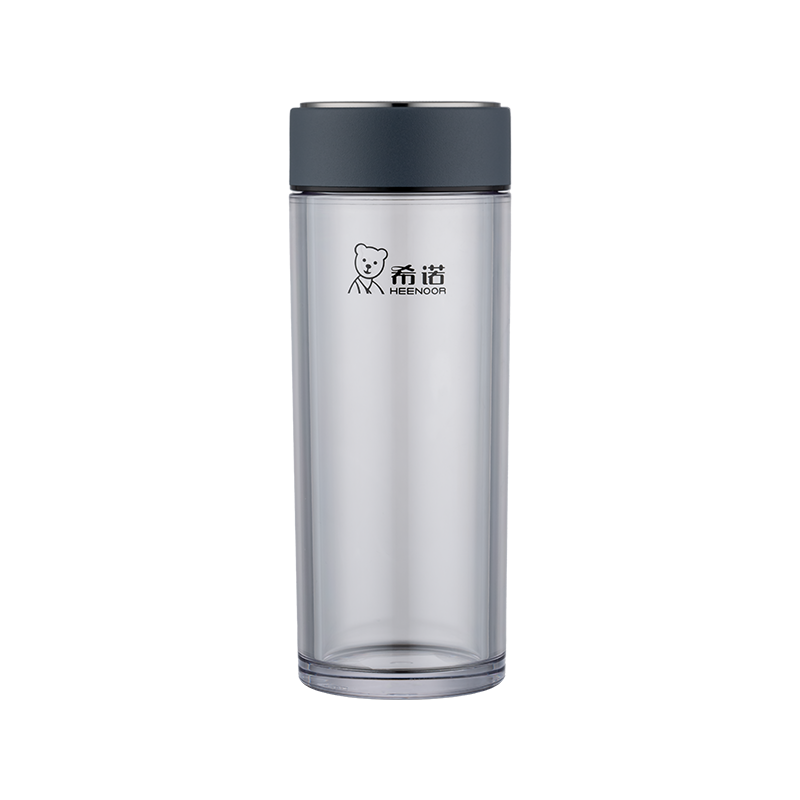
PC Car-Mounted Portable Anti-Fall Plastic Bottle: Durable Hydration for Mobile Lifestyles
Content
- 1 Introduction
- 2 1. Product Overview
- 3 2. Why Impact Resistance Matters in Portable Drinkware
- 4 3. Leak Prevention and Lid Engineering
- 5 4. Portability, Capacity, and Everyday Convenience
- 6 5. Applications Across Mobile and Professional Environments
- 7 6. Manufacturing Strengths and Integrated Product Development
- 8 7. Material Selection and Component Coordination
- 9 8. Advantages for Brand Owners and Procurement Teams
- 10 9. Practical Use and Care Guidance
- 11 10. Product Positioning in the Drinkware Market
- 12 11. Frequently Asked Questions
- 12.1 Q1: What material is used for the bottle body?
- 12.2 Q2: Is the bottle designed to resist falling?
- 12.3 Q3: What capacity is available?
- 12.4 Q4: What materials are used in the lid?
- 12.5 Q5: What type of sealing ring does the bottle use?
- 12.6 Q6: Can the bottle be carried upside down?
- 12.7 Q7: Is the bottle suitable for cars?
- 12.8 Q8: Is the bottle suitable for sports and outdoor activities?
- 12.9 Q9: What colors are listed?
- 12.10 Q10: What are the listed weights?
- 12.11 Q11: Is the bottle transparent?
- 12.12 Q12: Does the product meet safety or quality standards?
- 12.13 Q13: Can the product be customized?
- 12.14 Q14: What manufacturing capabilities support this product?
- 12.15 Q15: What should users check before using the bottle?
- 13 12. Conclusion
- 14 References
- 15 Product: PC Car-Mounted Portable Anti-Fall Plastic Bottle
Introduction
Portable hydration products have become essential for commuters, drivers, athletes, travelers, and outdoor users. A practical bottle must do more than hold water. It should be resistant to impact, comfortable to handle, easy to carry, secure against leakage, and suitable for repeated use in changing environments. The PC Car-Mounted Portable Anti-Fall Plastic Bottle is designed around these everyday requirements, combining a durable polycarbonate body, a reinforced structure, a compression-sealing lid, and a compact format intended for mobile use.
Unlike fragile glass bottles or lightweight containers that may deform easily, this bottle is designed to provide a stronger balance between portability and impact resistance. Its body uses PC material, a plastic known for high impact strength and resistance to cracking under ordinary accidental drops and bumps. The thickened cup design adds another layer of protection, making the bottle appropriate for vehicle use, outdoor activities, sports, fitness, and daily commuting.
The bottle also addresses one of the most common problems associated with portable drinkware: leakage. A heat-resistant silicone sealing ring is positioned within the lid assembly and forms a physical seal when the lid is closed. This compression-based sealing structure helps prevent water from escaping when the bottle is tilted, placed in a bag, or inverted during transport.
With a product description capacity of 530 ml and listed specification options of 300 ml and 400 ml, the product family can support different hydration preferences and carrying requirements. The compact body, rounded mouth, rounded lid, transparent appearance, and restrained color options give the bottle a simple, adaptable look for both practical and professional settings.
Behind the product is a manufacturing organization with experience in drinkware development, engineering validation, tooling, standardized production, and quality management. Heenoor Co., Ltd., founded in 1999, works with stainless steel, titanium, plastic, and glass drinkware. Its integrated manufacturing model allows product concepts to move through design, testing, tooling, production, and quality control within a coordinated industrial system.
This article examines the bottle’s construction, performance advantages, applications, manufacturing process, customization potential, and suitability for buyers seeking dependable drinkware programs.
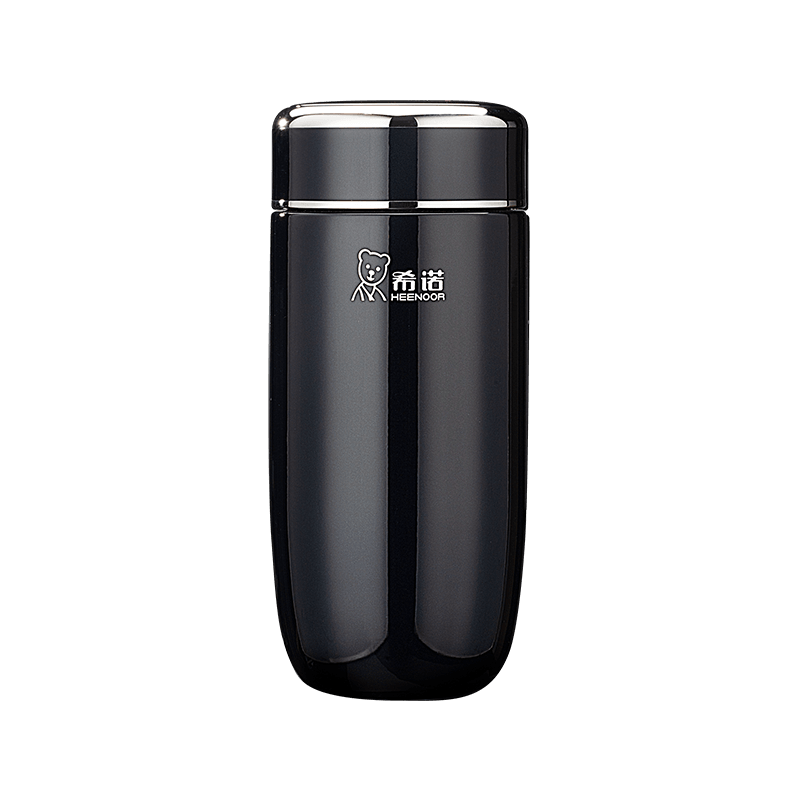
PC Car-Mounted Portable Anti-Fall Plastic Bottle
1. Product Overview
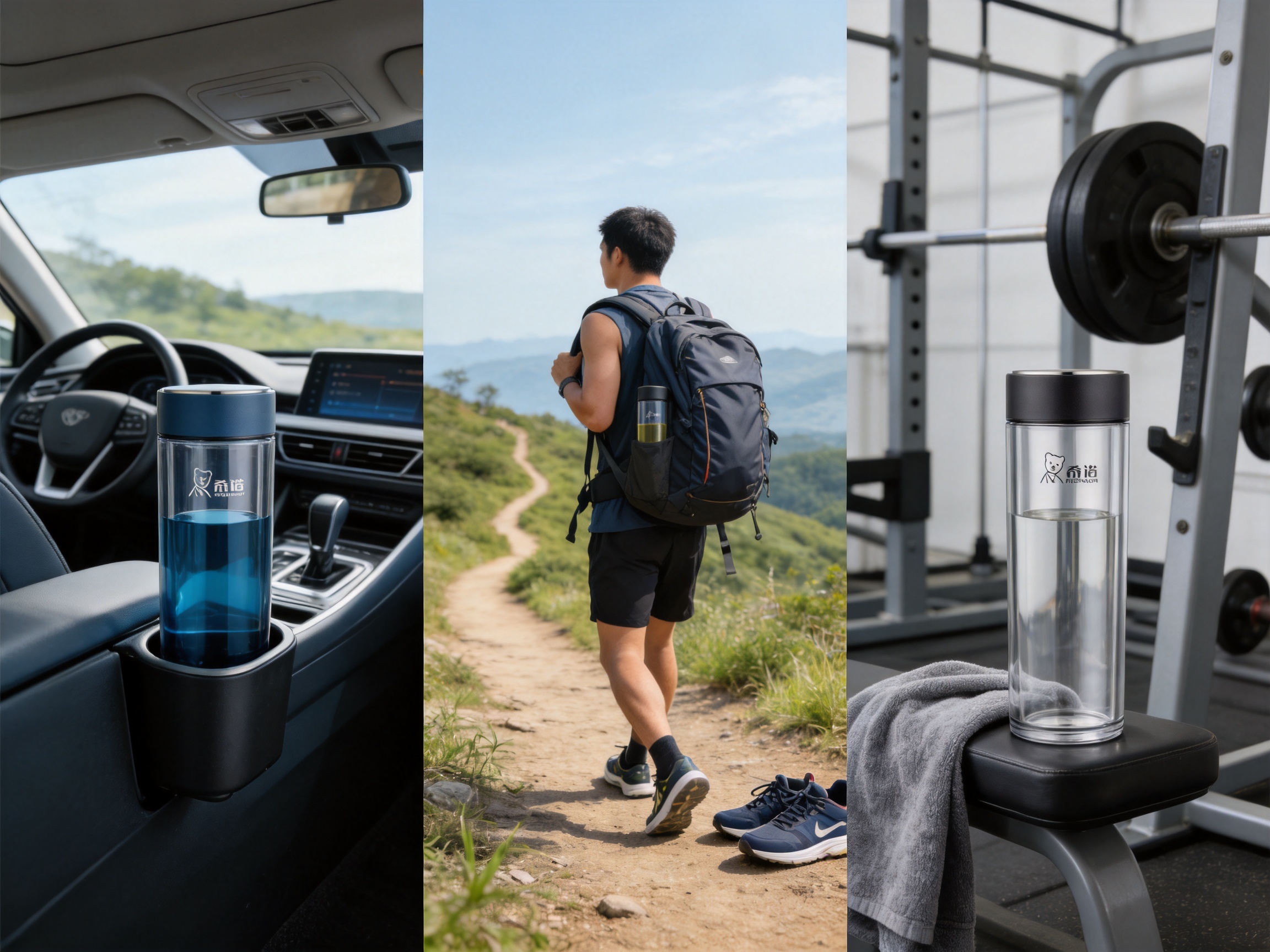
The PC Car-Mounted Portable Anti-Fall Plastic Bottle is a reusable plastic water bottle developed for users who need reliable hydration while moving between locations. Its intended environments include cars, offices, gyms, hiking routes, sports venues, travel situations, and general daily commuting.
The defining feature is its PC body. Polycarbonate is selected for applications in which impact resistance is more important than the extremely light weight associated with some thin plastic containers. In practical use, the material helps the bottle withstand the bumps, knocks, and accidental drops that are common when drinkware is stored in vehicles, backpacks, sports bags, or work areas.
The bottle is described as having a thickened design. This construction supports the anti-fall positioning of the product by providing additional structural material in the cup body. A thickened wall can help reduce the likelihood of cracking or sudden failure when the container encounters a hard surface, although actual performance will always depend on the height, angle, surface, temperature, and condition of each impact.
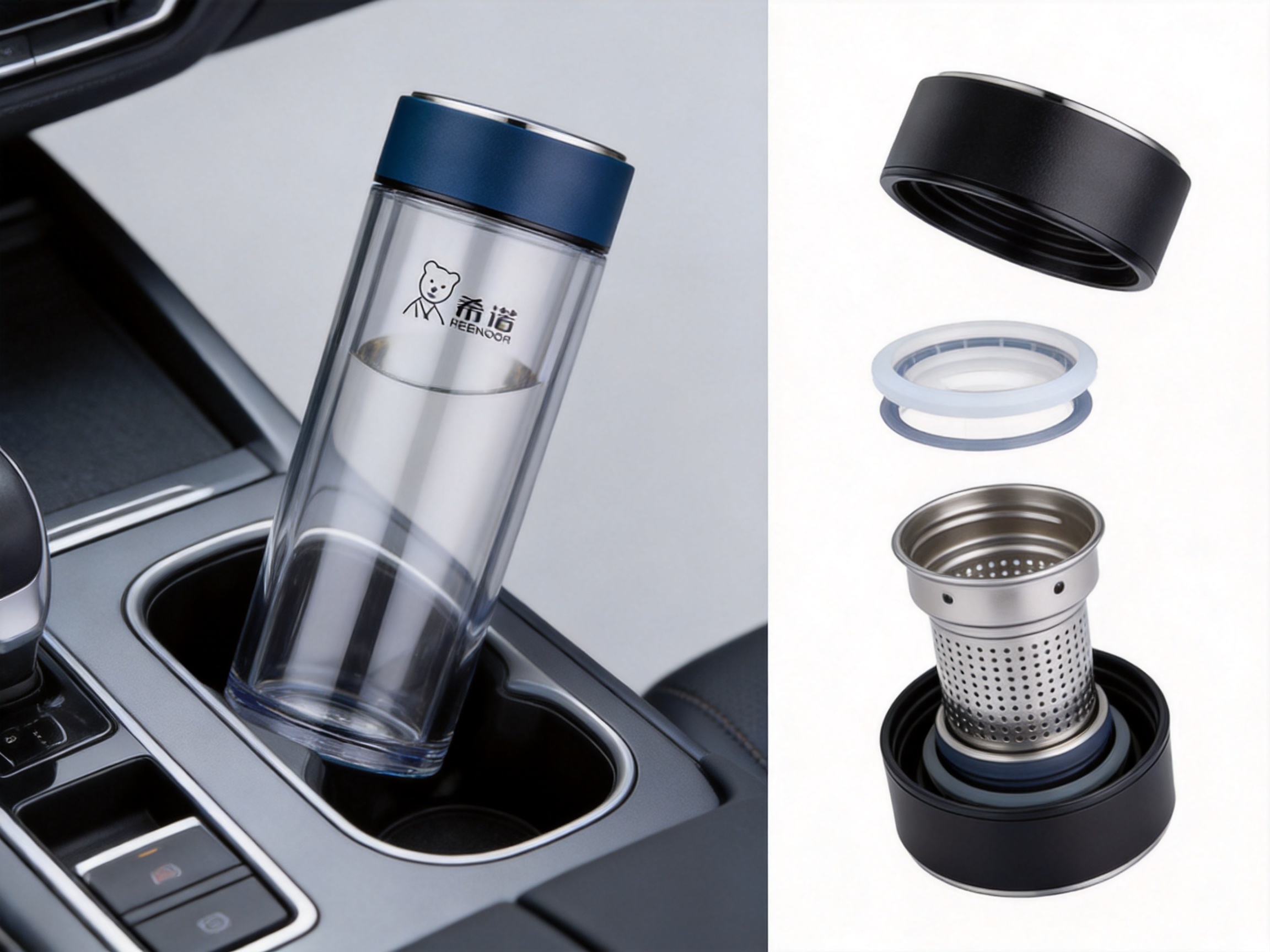
The lid combines 304 stainless steel and PP components. This combination provides a practical balance between appearance, structural utility, and manufacturability. The stainless steel element adds a durable, refined surface, while polypropylene supports functional plastic components within the lid system. A heat-resistant silicone rubber ring completes the sealing structure.
The product’s rounded mouth and lid are intended to create a smoother tactile experience. Rounded edges can make the bottle more comfortable to hold and drink from while also reducing sharp contact points. The clear body makes the water level visible, allowing users to check remaining contents without opening the lid.
Key Product Characteristics
The main product characteristics can be summarized as follows:
| Feature | Product Information | Practical Benefit |
|---|---|---|
| Product type | Portable plastic water bottle | Suitable for travel, commuting, sports, and outdoor use |
| Cup body | PC material | High impact resistance and reduced breakage risk |
| Design | Thickened anti-fall structure | Improved resistance to ordinary bumps and accidental drops |
| Lid | 304 stainless steel and PP | Durable, practical, and visually adaptable construction |
| Sealing ring | Heat-resistant silicone rubber | Compression-based leak prevention |
| Listed capacities | 300 ml and 400 ml specifications; 530 ml product description | Options for different carrying and hydration requirements |
| Listed weights | 0.36 kg and 0.46 kg | Defined product configurations for procurement planning |
| Colors | Deep Sea Blue and Palace Silver | Professional appearance with differentiated visual options |
Because the supplied materials present both a 530 ml product description and 300 ml/400 ml specification values, buyers should confirm the exact capacity, weight, and configuration before placing an order. This may reflect different versions, product listings, or packaging specifications within the same product family.
2. Why Impact Resistance Matters in Portable Drinkware
Drinkware used in mobile settings is exposed to more physical stress than drinkware kept on a stationary table. A bottle in a vehicle may slide during braking or acceleration. A bottle in a backpack may be compressed by other items. A bottle used in a gym may fall from a bench or locker. Outdoor users may place it on uneven ground, rocks, or hard surfaces. These situations create a need for a container that can tolerate ordinary handling without becoming unusable after one incident.
Glass offers a premium appearance and excellent transparency, but it can break when dropped. Thin plastic can be light and economical, but it may be more vulnerable to deformation, stress marks, or cracking. Metal bottles can provide strong bodies, yet some users prefer a transparent container that allows direct visual monitoring of the water level. The PC body of this bottle is intended to occupy a practical position between these common alternatives.
PC material is particularly suitable when impact resistance and dimensional stability are important. Its use in the cup body supports a product concept built around durability rather than disposable convenience. The thicker construction further supports this positioning by giving the body a more substantial structure than a very thin single-use bottle.
Anti-fall performance should not be interpreted as indestructibility. No consumer bottle can be guaranteed to remain undamaged under every impact condition. However, the combination of PC material and thickened construction gives the bottle a meaningful advantage for ordinary mobile use. It is designed to reduce the risk of breakage during normal transportation and handling, helping users avoid the inconvenience of sudden spills, sharp fragments, or premature replacement.
For procurement teams, this durability can also have lifecycle value. A bottle that remains functional after repeated daily handling may reduce replacement frequency compared with fragile or poorly constructed alternatives. In branded programs, institutional purchasing, travel kits, employee gifts, and sports promotions, product durability can also help preserve the perceived value of the item over time.
Advantages Compared with Common Alternatives
Compared with glass bottles, the PC body is less likely to shatter when subjected to ordinary accidental drops. This is particularly useful in cars, gyms, schools, workplaces, and outdoor environments where a broken bottle could create safety and cleaning concerns.
Compared with thin disposable plastic containers, the thickened reusable body is intended for more durable, repeat-use conditions. The product is designed as a manufactured drinkware item rather than a temporary packaging container, giving it a stronger functional identity and a more substantial user experience.
Compared with opaque bottles, the transparent body makes it easier to see the remaining water. Users can quickly determine whether the bottle needs to be refilled without removing the lid or relying on an approximate weight.
Compared with poorly sealed portable bottles, the silicone sealing ring and compression-based lid structure are intended to provide better protection against leaks during inversion and transport. This is especially important when the bottle is carried alongside clothing, electronics, documents, or food.
Compared with highly specialized insulated vessels, the product emphasizes compact portability, visibility, and impact resistance. It is therefore suitable for users who prioritize a straightforward hydration container rather than temperature-retention performance as the primary requirement.
3. Leak Prevention and Lid Engineering
A bottle body may be strong, but the product cannot perform well if the lid leaks. Portable drinkware is often placed in positions that are not perfectly upright. It may lie horizontally in a car holder, tilt inside a backpack, or be inverted while being removed from a bag. The lid therefore needs to create a consistent seal around the mouth of the container.
The bottle uses a heat-resistant silicone rubber sealing ring. Silicone is commonly selected for sealing applications because it is flexible, resilient, and capable of maintaining contact under ordinary changes in position. When the lid is tightened or closed, the ring is compressed against the relevant sealing surfaces. This physical compression creates a barrier that helps prevent liquid from passing through the joint.
The sealing mechanism is mechanical rather than dependent on adhesives or temporary coatings. A correctly fitted ring can be removed for cleaning or replacement, subject to the final product design and maintenance instructions. Its flexibility also allows it to accommodate minor variations in contact between the lid and bottle mouth.
The rounded mouth and lid contribute to user comfort and handling. Smooth edges are easier to touch and reduce the likelihood of discomfort when drinking or opening the container. The lid’s 304 stainless steel and PP construction combines a metal component with engineered plastic elements, supporting both visual appeal and functional assembly.
Leak resistance depends on proper closure, cleanliness, and the condition of the sealing ring. Users should ensure that the ring is correctly positioned and that the contact surfaces are free of dirt, sugar residue, or other particles. Cross-threading, over-tightening, or incomplete closure can also reduce sealing performance. For commercial buyers, clear care instructions can help maintain the product’s intended performance throughout its service life.
4. Portability, Capacity, and Everyday Convenience
Portability is one of the bottle’s central design objectives. A mobile bottle must be large enough to provide useful hydration but compact enough to carry without becoming a burden. The supplied product description identifies a 530 ml capacity, while the specification table lists 300 ml and 400 ml options. These values suggest that the product family may be offered in multiple configurations or that different listings refer to different versions.
A 530 ml format is appropriate for users who want a moderate amount of water for commuting, short outdoor trips, workouts, or daily errands. It provides more capacity than a very small personal bottle without becoming as bulky as a large outdoor hydration vessel. The 300 ml and 400 ml options may be useful where compact size, lower weight, or controlled serving volume is more important.
Capacity selection can be matched to the application. A smaller configuration may fit more easily into vehicle compartments, handbags, children’s bags, or compact equipment kits. A larger configuration may reduce the number of refills required during a longer commute or exercise session. For businesses, different sizes can also support different promotional packages, retail price points, or user groups.
The bottle’s transparent body offers immediate visibility of the contents. This feature is especially helpful when users need to monitor hydration during exercise or confirm whether the bottle has been filled. It also supports operational convenience in offices, hospitality environments, and group activities.
The listed weights are 0.36 kg and 0.46 kg for the specified configurations. Although weight can vary depending on the exact model, lid assembly, packaging, and production version, these figures provide a useful reference for shipping calculations and product planning. Procurement teams should request a final technical data sheet when weight is critical to logistics, retail compliance, or travel kits.
The listed color options are Deep Sea Blue and Palace Silver. Deep Sea Blue can create a calm, active, or outdoor-oriented appearance, while Palace Silver gives the bottle a more neutral and refined visual character. Both colors can be used in professional or consumer-facing programs without requiring highly specialized styling.
5. Applications Across Mobile and Professional Environments
Car and Vehicle Use
The product name emphasizes car-mounted use, and its compact, impact-resistant construction is well suited to vehicle environments. A bottle placed in a vehicle may encounter vibration, sudden movement, and limited storage space. Its durable body helps address the risk of accidental knocks, while the sealing ring helps protect the surrounding interior from leakage.
Drivers can use the bottle during commuting, delivery work, road travel, and extended journeys. Passengers may also appreciate a clear body that allows the water level to be checked quickly. The final suitability for a particular vehicle holder will depend on the holder’s diameter and depth, so buyers should verify dimensional compatibility before deployment.
Outdoor Activities
Outdoor environments create frequent contact with hard or uneven surfaces. Hiking, camping, sightseeing, fishing, and travel can all involve placing a bottle on the ground or carrying it in a crowded bag. PC material and a thickened body provide a practical response to these conditions by reducing the likelihood of immediate damage from ordinary knocks.
The bottle is not presented as a specialized expedition container, thermal flask, or pressure-rated outdoor vessel. Instead, it offers straightforward hydration support for general outdoor activities where convenience, visibility, and impact resistance are valued.
Sports and Fitness
During exercise, bottles are frequently moved between lockers, benches, training machines, and sports bags. They may be knocked over or dropped while users are focused on their activity. A durable body and leak-resistant lid can help reduce interruptions caused by spills or breakage.
The transparent design also makes it easy to monitor consumption during training. The available capacity range can support short workouts, gym sessions, recreational sports, and fitness programs. Organizations that operate gyms, clubs, or sporting events may consider the bottle for staff use, participant kits, or promotional distribution.
Daily Commuting and Workplace Use
For commuters, a reusable bottle can be carried between home, transportation, and the workplace. Its compact design is intended to support this regular movement. The simple appearance can fit business, educational, industrial, and personal environments without appearing overly specialized.
The bottle may also be suitable for employee wellness programs, company events, training sessions, conferences, and customer promotions. A durable item that is used repeatedly can provide more continuing visibility than a disposable promotional product, especially when quality and presentation are important.
6. Manufacturing Strengths and Integrated Product Development
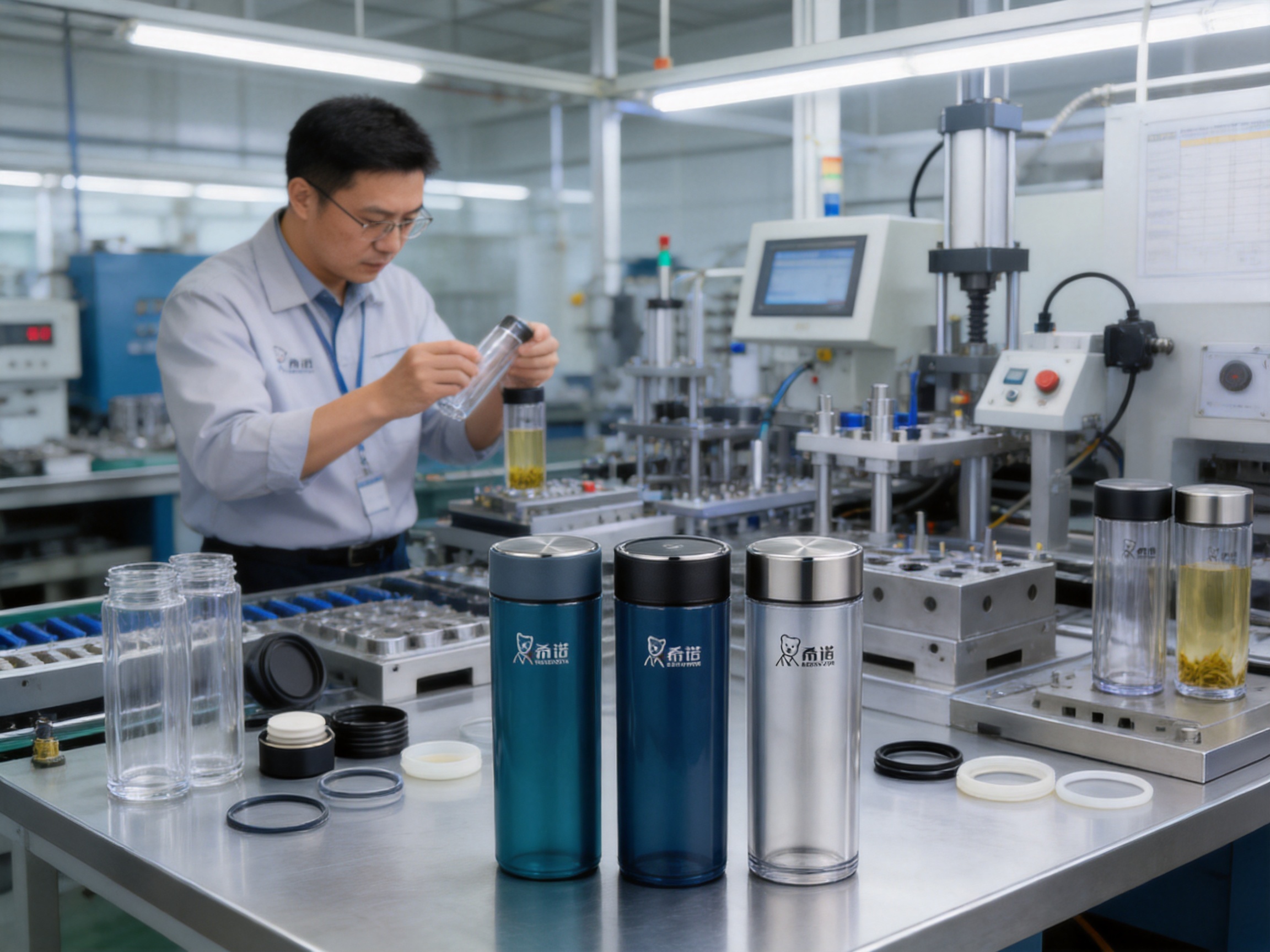
The product’s performance depends not only on its material selection but also on the manufacturing discipline used to convert a design into a consistent finished item. Heenoor Co., Ltd. was founded in 1999 and has developed experience in drinkware product development and industrial manufacturing. Its capabilities include product design, engineering validation, tooling development, standardized production, and quality management.
An integrated development structure can improve communication between design and production teams. When product designers, engineers, tooling specialists, and quality personnel work within a coordinated system, potential problems can be identified earlier. This is particularly important for products that combine PC, PP, stainless steel, and silicone components, because each material has different processing and performance characteristics.
Product Design
Product design establishes the relationship between the bottle’s visual appearance, ergonomics, material thickness, lid structure, and intended applications. For this bottle, design priorities include a compact form, rounded contact surfaces, clear visibility, a durable body, and a lid capable of supporting a reliable seal.
Design decisions must also consider manufacturability. A shape that looks attractive but is difficult to mold, assemble, inspect, or clean may create unnecessary cost and quality risk. Industrial drinkware design therefore requires a balance between appearance, user comfort, structural performance, and production efficiency.
Engineering Validation
Engineering validation helps determine whether the product can meet its intended functional requirements. For an anti-fall plastic bottle, relevant considerations may include body impact resistance, lid fit, sealing behavior, dimensional stability, thread or closure performance, and resistance to repeated handling.
Validation can include design reviews, prototype evaluation, assembly checks, dimensional inspection, leakage observation, and simulated handling. The exact tests applied will depend on the product version, intended market, customer requirements, and applicable standards. The supplied materials state that the product meets national standards and has been certified by professional testing organizations, providing additional support for its market positioning.
Tooling Development
Tooling has a direct influence on the consistency of molded components. The bottle body and PP lid components require molds that can reproduce the intended dimensions and surface features. Proper tooling development supports repeatability across production batches and helps control fit between the bottle mouth, lid, and silicone sealing ring.
Tooling specialists must consider material flow, wall thickness, cooling, shrinkage, part release, surface finish, and long-term mold maintenance. For transparent or semi-transparent PC components, surface quality and processing control are especially important because visible defects can affect appearance and customer acceptance.
Standardized Production
Standardized production helps transform validated product designs into stable, repeatable manufacturing programs. Standard operating procedures can define material preparation, molding conditions, component inspection, assembly methods, sealing-ring installation, cleaning, packaging, and final release.
Consistency is particularly important when a product contains multiple materials. The PC body must be compatible with the lid assembly. The 304 stainless steel and PP components must be assembled correctly. The silicone ring must be positioned accurately and remain secure during normal use. Standardized procedures reduce variation and give production personnel clear guidance.
Quality Management
Quality management provides a framework for preventing defects and identifying problems before shipment. It may include incoming material inspection, in-process checks, first-piece approval, dimensional verification, appearance inspection, assembly testing, leak checks, and final sampling.
For buyers, quality management is important because product reliability must be maintained across volume orders, not only in prototype samples. A manufacturing partner with established quality practices can provide more dependable support for repeat purchases, private-label programs, and international distribution.
7. Material Selection and Component Coordination
The product uses several materials, each selected for a specific role. PC forms the bottle body and contributes impact resistance and transparency. 304 stainless steel is included in the lid assembly and contributes a durable metal surface. PP supports additional lid components and offers a practical material for molded functional parts. Heat-resistant silicone rubber forms the sealing ring and provides flexibility for compression sealing.
Material coordination is essential. A bottle is not evaluated only by the performance of its individual materials. The body, lid, and sealing ring must work together as a complete system. The dimensions of the mouth must correspond with the lid. The sealing ring must contact the intended surfaces with suitable compression. The lid components must remain properly assembled during repeated opening and closing.
PC’s transparency supports visual monitoring, but transparent molded parts require attention to appearance, processing, and handling. PP can support lightweight, durable lid components, while 304 stainless steel can add a more substantial finish. Silicone’s flexibility allows it to form a seal without requiring a rigid insert that could be more sensitive to small dimensional variations.
For customers with specific compliance requirements, the final material specifications, testing documents, and declarations should be confirmed for the intended market. Requirements may differ by region, application, liquid type, labeling format, and sales channel. The manufacturer’s experience across plastic, stainless steel, titanium, and glass drinkware can support discussions about these requirements.
8. Advantages for Brand Owners and Procurement Teams
Brand owners often need products that combine reliable performance with a scalable manufacturing process. A bottle may be selected for retail, promotional distribution, corporate programs, hospitality, travel, education, or sports. In each case, the buyer needs confidence that the product can be reproduced consistently and supplied according to schedule.
The integrated capabilities associated with Heenoor support a structured approach to such programs. Product development, tooling, production, and quality management can be coordinated rather than handled as isolated stages. This can simplify communication and help reduce the risk that a design will be approved without adequate consideration of production requirements.
The bottle’s neutral, versatile appearance may also be useful for customization programs. Deep Sea Blue and Palace Silver provide starting points for visual differentiation, while the simple body design can potentially support additional branding subject to technical review. Buyers should discuss printing, marking, packaging, color matching, minimum order quantities, and artwork approval directly with the manufacturer.
For procurement teams, the product offers several planning advantages. Its defined materials make it easier to prepare technical documentation. Its compact form can simplify storage and distribution. Multiple capacity configurations may allow the same product family to serve different customer segments. Its use across commuting, sport, outdoor, and promotional applications can also support broader purchasing programs.
A long-term manufacturing partner should be evaluated not only on unit price but also on engineering response, tooling control, quality consistency, communication, packaging capability, and the ability to support future revisions. Heenoor positions itself as a manufacturing partner for brands, organizations, and procurement teams that value technical clarity, disciplined production, and supply stability.
9. Practical Use and Care Guidance
To maintain the intended performance of the bottle, users should inspect the lid and sealing ring before use. The silicone ring should be seated correctly and should not be twisted, displaced, or visibly damaged. The lid should be closed completely without forcing it beyond its normal operating position.
The bottle should be cleaned regularly, particularly after use with flavored beverages, sports drinks, sweetened liquids, or other drinks that may leave residue. The mouth, lid, and sealing ring should receive attention because residue in these areas can affect taste, hygiene, and sealing performance.
Although the PC body is designed for impact resistance, users should not intentionally throw, crush, or subject the bottle to extreme force. A drop-resistant design reduces risk during normal use but does not eliminate the possibility of damage. Any bottle showing cracks, severe scratches, deformation, or a compromised lid should be removed from service.
Users should also follow the manufacturer’s instructions regarding temperature, cleaning methods, and liquid compatibility. The supplied information identifies the sealing ring as heat-resistant silicone rubber, but this does not automatically mean that every component is suitable for all high-temperature liquids or heating methods. The final product documentation should be consulted for exact limitations.
For commercial programs, care instructions can be included with packaging or communicated through product literature. Clear instructions help customers obtain better performance, reduce misuse, and extend the useful life of the product.
10. Product Positioning in the Drinkware Market
The PC Car-Mounted Portable Anti-Fall Plastic Bottle occupies a practical segment of the reusable drinkware market. It is not designed primarily as a luxury insulated flask, a technical mountaineering bottle, or a disposable packaging container. Its value comes from combining durable plastic construction, portable capacity, transparent visibility, straightforward styling, and a leak-resistant lid.
This positioning gives it broad relevance. Consumers who need a bottle for ordinary daily movement may value its convenience. Fleet operators and drivers may appreciate its vehicle-oriented practicality. Sports and outdoor users may prefer its impact-resistant body. Businesses may view it as a useful promotional or employee product because it is reusable and suitable for repeated visibility.
The product can also complement, rather than replace, other drinkware categories. Stainless steel vacuum flasks may be chosen when insulation is the primary requirement. Glass bottles may appeal to users who prioritize a particular material feel. Large outdoor bottles may provide greater capacity. In contrast, this PC bottle is a strong option when portability, transparency, and resistance to ordinary impact are central priorities.
Its competitive advantage is therefore based on balance. It combines several desirable features without relying on a highly complex mechanism. The body is durable without being opaque. The lid is functional without being overly complicated. The form is practical without appearing industrial or disposable. The product is suitable for users who want dependable everyday performance in a compact format.
11. Frequently Asked Questions
Q1: What material is used for the bottle body?
The bottle body is made of PC material. Polycarbonate is selected for its high impact resistance and suitability for portable products that may experience bumps or accidental drops.
Q2: Is the bottle designed to resist falling?
Yes. The product uses an impact-resistant PC body and a thickened design intended to improve resistance to ordinary drops and knocks. It should not be considered indestructible, and users should avoid intentionally exposing it to extreme force.
Q3: What capacity is available?
The product description identifies a 530 ml capacity. The supplied specification table lists 300 ml and 400 ml configurations. Buyers should confirm the exact capacity and model before ordering, as these figures may represent different versions or listings.
Q4: What materials are used in the lid?
The lid is listed as 304 stainless steel plus PP. These materials provide a combination of durable metal and practical molded plastic components.
Q5: What type of sealing ring does the bottle use?
The sealing ring is made of heat-resistant silicone rubber. It helps create a leak-resistant seal through physical compression when the lid is properly closed.
Q6: Can the bottle be carried upside down?
The sealing structure is designed to help prevent leakage when the bottle is inverted. For best results, the lid must be fully closed, the sealing ring must be correctly positioned, and the contact surfaces must be clean and undamaged.
Q7: Is the bottle suitable for cars?
Yes. Its compact, portable design and impact-resistant body are suitable for vehicle use. Users should verify that the selected capacity and dimensions fit the particular car-mounted holder or storage compartment.
Q8: Is the bottle suitable for sports and outdoor activities?
Yes. The product is described as suitable for outdoor trips, sports and fitness, and daily commuting. Its PC body, visible water level, portable capacity, and sealing structure support these applications.
Q9: What colors are listed?
The listed colors are Deep Sea Blue and Palace Silver. Final color availability, production quantities, and customization options should be confirmed with the manufacturer.
Q10: What are the listed weights?
The supplied information lists weights of 0.36 kg and 0.46 kg. The exact weight may vary according to the selected capacity, product version, lid configuration, and packaging. A final technical specification should be requested for purchasing and shipping calculations.
Q11: Is the bottle transparent?
The product description states that the cup body is clear. This allows users to view the water level and gives the bottle a simple, versatile appearance.
Q12: Does the product meet safety or quality standards?
The supplied materials state that the product meets national standards and has been certified by professional testing organizations. Buyers should request the applicable certificates and current documentation for the target market and final product configuration.
Q13: Can the product be customized?
Customization should be discussed directly with the manufacturer. Potential topics may include color, marking, packaging, capacity, artwork, and project-specific requirements. Feasibility will depend on tooling, order volume, materials, and compliance needs.
Q14: What manufacturing capabilities support this product?
The manufacturer provides product design, engineering validation, tooling development, standardized production, and quality management. It has experience with stainless steel, titanium, plastic, and glass drinkware.
Q15: What should users check before using the bottle?
Users should check that the bottle body is undamaged, the lid closes correctly, and the silicone sealing ring is properly positioned. The bottle should be cleaned regularly and removed from service if cracks, severe deformation, or sealing damage appear.
12. Conclusion
The PC Car-Mounted Portable Anti-Fall Plastic Bottle is designed for people who need practical hydration in mobile environments. Its PC body provides a strong foundation for impact resistance, while the thickened construction supports the product’s anti-fall positioning. The 304 stainless steel and PP lid, together with a heat-resistant silicone sealing ring, create a functional closure system intended to reduce leakage during transport and inversion.
The clear body, rounded mouth, compact format, and listed capacity options support everyday convenience. The product is suitable for car use, outdoor trips, sports and fitness, travel, and daily commuting. Its balance of durability, visibility, portability, and simple appearance gives it advantages over fragile glass, thin disposable plastic, and less secure portable containers.
For commercial buyers, the product is supported by a manufacturing organization with experience in drinkware development and industrial production. Heenoor’s capabilities in design, engineering validation, tooling, standardized manufacturing, and quality management provide a foundation for consistent supply and project support. Its experience across multiple drinkware materials also allows it to address a wide range of product requirements.
Buyers should confirm the exact capacity, weight, dimensions, certification documents, packaging details, and customization conditions for the chosen configuration. With those details established, the bottle can serve as a dependable option for brands, organizations, distributors, and users seeking durable reusable drinkware for active, professional, and everyday applications.
References
1. Heenoor Co., Ltd. Product information for the PC Car-Mounted Portable Anti-Fall Plastic Bottle, including material, capacity, color, weight, lid, and sealing-ring specifications.
2. Heenoor Co., Ltd. Company information regarding product design, engineering validation, tooling development, standardized production, and quality management.
3. General technical reference materials on polycarbonate properties, including impact resistance, transparency, and dimensional stability in reusable product applications.
4. General technical reference materials on 304 stainless steel for consumer product components and drinkware assemblies.
5. General technical reference materials on polypropylene and silicone rubber in molded closures, gaskets, and compression-sealing applications.
6. General product-development principles for reusable drinkware, including design for manufacturability, leak testing, dimensional control, and lifecycle quality management.
Product: PC Car-Mounted Portable Anti-Fall Plastic Bottle

You may also like…
Copyright © 2025 Heenoor Co., Ltd. All Rights Reserved.
 Custom Stainless Steel Drinkware Manufacturers
BACK TOP