 English
 中文简体
中文简体 日本語
日本語 Español
 عربى
عربى
Search
Categories
Recommend
Categories
 Lin Yuxi — International Product Sales Manager
Recommend
-
 Industry news
 -
 Industry news
 -
 Industry news
 -
 Industry news
Sep 06, 2026 - By admin
Pure Titanium Vacuum Flask: Material Purity, Thermal Performance, and Manufacturing Excellence
Content
- 1 1. The Role of Material Selection in Premium Drinkware
- 2 2. Double-Wall Vacuum Insulation and Temperature Retention
- 3 3. Structural Design and Everyday User Experience
- 4 4. Manufacturing Process and Engineering Capabilities
- 5 5. Advantages for Brands, Distributors, and Procurement Teams
- 6 6. Practical Use and Care Considerations
- 7 7. Product Positioning and Competitive Differentiation
- 8 8. Why Manufacturing Discipline Matters
- 9 9. Suitable Application Scenarios
- 10 10. Frequently Asked Questions
- 10.1 Q1: What material is used for the bottle body?
- 10.2 Q2: Is the flask suitable for beverages other than water?
- 10.3 Q3: Does the flask contain lead, cadmium, or arsenic?
- 10.4 Q4: How well does it retain hot water?
- 10.5 Q5: How well does it retain cold water?
- 10.6 Q6: What is the purpose of the double-wall vacuum structure?
- 10.7 Q7: Does the bottle use paint for its color?
- 10.8 Q8: Is the flask heavy to carry?
- 10.9 Q9: What is the function of the silicone ring at the bottom?
- 10.10 Q10: Is the mouth comfortable for direct drinking?
- 10.11 Q11: Is the flask suitable for outdoor use?
- 10.12 Q12: Can the product be customized for brands or organizations?
- 10.13 Q13: What manufacturing capabilities support the product?
- 10.14 Q14: Why is titanium advantageous compared with ordinary stainless steel?
- 10.15 Q15: What should buyers request before placing a large order?
- 11 11. Conclusion
- 12 References
- 13 Product: Pure Titanium Business Vacuum Flask
In the modern drinkware market, consumers and professional buyers are looking for more than an attractive container for hot or cold beverages. A high-quality vacuum flask must combine material safety, thermal efficiency, durability, ease of use, portability, and consistent manufacturing quality. It must also perform reliably across different environments, from daily commuting and office use to outdoor travel, business activities, and demanding field conditions.
The Pure Titanium Business Vacuum Flask is designed around these requirements. Its bottle body, inner lid, and filter are manufactured from industrial pure titanium with a stated purity exceeding 99.6%. This material choice places the product in a premium category above conventional stainless steel, plastic, and coated drinkware. Titanium offers a distinctive combination of corrosion resistance, low weight, mechanical stability, and compatibility with a wide range of beverages.
At the same time, the product is not defined by titanium alone. Its double-wall vacuum construction is engineered to reduce heat conduction and convection, helping preserve beverage temperature for extended periods. An anodized surface treatment creates natural color without relying on a conventional paint coating. A rounded, thickened mouth improves drinking comfort, while a silicone ring at the base supports stability and slip resistance.
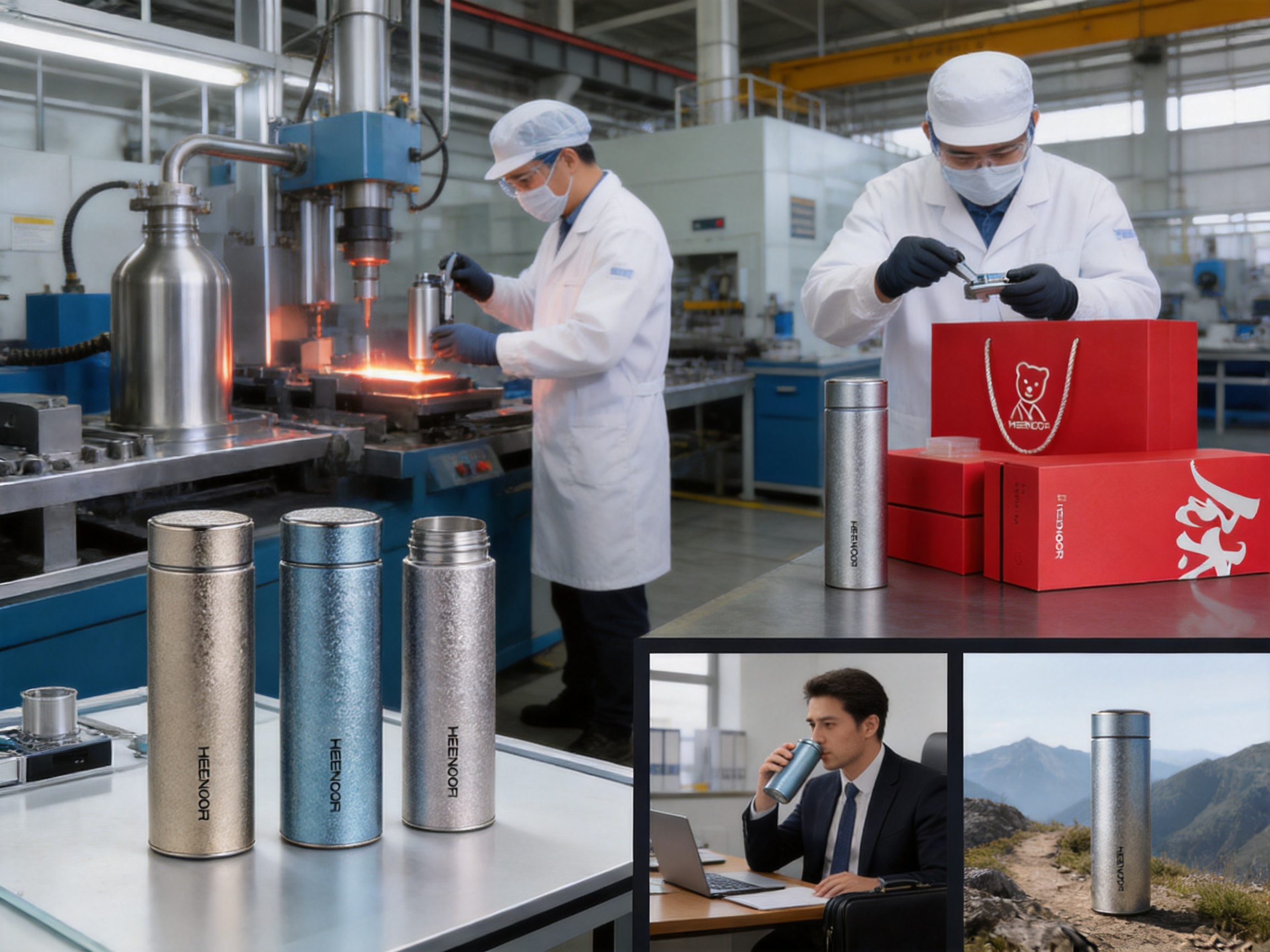
Behind the finished product is a manufacturing system that combines product development, engineering validation, tooling development, standardized production, and quality management. These capabilities are important because premium drinkware requires more than a good concept. It demands precision forming, controlled welding or joining processes, effective vacuum insulation, surface-treatment consistency, dimensional control, and reliable inspection from raw material to finished shipment.
This article examines the product’s material advantages, thermal behavior, structural design, user experience, manufacturing value, quality considerations, and suitability for business and customized drinkware programs.
1. The Role of Material Selection in Premium Drinkware
The material in contact with a beverage directly influences the product’s safety, durability, taste neutrality, weight, and service life. Many drinkware products use stainless steel because it offers a useful balance between cost, strength, manufacturability, and corrosion resistance. Plastic products can be economical and lightweight, while glass is valued for its visual clarity and neutral contact surface. Titanium, however, provides a different performance profile that is especially attractive for premium, technical, outdoor, and health-conscious applications.
The Pure Titanium Business Vacuum Flask uses industrial pure titanium with a purity exceeding 99.6% for the bottle body, inner lid, and filter. Using the same premium material across these important components supports a consistent product concept and reduces dependence on multiple material systems in the beverage-contact area.
Titanium naturally reacts with oxygen in the air to form a dense and stable oxide film. This passive surface layer contributes to its resistance to corrosion under ordinary conditions. As a result, titanium is suitable for contact with many common beverages, including water, tea, coffee, milk, fruit juice, and traditional herbal drinks. The material is not intended to chemically react with these beverages under normal room-temperature use, and its stable surface helps reduce concerns related to corrosion or metallic leaching.
For buyers comparing drinkware materials, this characteristic is important. A beverage container should not easily absorb odors, become discolored by ordinary drinks, or develop visible corrosion during its useful life. A stable titanium interior can help maintain a clean and neutral drinking experience when the flask is used and cleaned appropriately.
1.1 High Purity and Beverage Contact
Material purity is one of the key factors distinguishing premium titanium drinkware from products that use titanium only as a decorative or partial component. In this flask, the bottle body, inner lid, and filter are specified as industrial pure titanium with a purity exceeding 99.6%. This specification provides buyers with a clear basis for evaluating the product rather than relying only on the word “titanium” in marketing communication.
Third-party test reports cited for the product indicate that heavy metals including lead, cadmium, and arsenic were not detected. This information is relevant for brands, distributors, procurement teams, and end users who need confidence in the material system. It also supports the product’s positioning as a safer premium option for repeated beverage use.
Although no drinkware material eliminates the need for proper cleaning and responsible use, a high-purity titanium contact surface offers several practical benefits. It can be used with a wide variety of beverages, is resistant to corrosion under ordinary conditions, and is less likely to introduce the odor or taste sometimes associated with lower-grade materials, degraded coatings, or poorly maintained containers.
1.2 Titanium Compared with Common Alternatives
Stainless steel remains one of the most widely used materials in insulated drinkware. It is strong, relatively affordable, and well suited to mass production. However, titanium can offer a lower weight and a distinctive corrosion-resistance profile. For buyers who value portability, premium material identity, and long-term surface stability, titanium may provide advantages over mainstream stainless steel designs.
Plastic bottles are generally lightweight and economical, but they may be less suitable for users who require high-temperature retention, a premium tactile experience, or long-term resistance to staining and odor absorption. Certain plastics also have temperature limitations that restrict their use with hot beverages.
Glass provides a neutral beverage-contact surface and allows users to see the contents, but it is vulnerable to impact and is usually heavier relative to its capacity. It also does not naturally provide the same combination of vacuum-insulation performance and impact resilience expected from a metal double-wall flask.
Painted or coated metal bottles can offer attractive colors, but surface coatings may scratch, chip, or wear through repeated use. The Pure Titanium Business Vacuum Flask uses anodizing technology to create natural colors without a conventional paint coating. This approach supports a more integrated surface appearance and can reduce concerns associated with a separate external paint layer.
| Evaluation Factor | Pure Titanium Vacuum Flask | Stainless Steel Flask | Plastic Bottle | Glass Bottle |
|---|---|---|---|---|
| Beverage-contact stability | High under ordinary use, supported by a stable oxide film | Generally high, depending on grade and finish | Depends on polymer type and temperature conditions | High when the glass is intact and properly manufactured |
| Weight potential | Lightweight premium metal construction | Moderate to relatively heavy | Very light | Usually heavier and more fragile |
| Corrosion resistance | Strong resistance under ordinary conditions | Strong, depending on steel grade and environment | Does not rust, but may stain or degrade under some conditions | Does not rust, but may be vulnerable to breakage |
| External color approach | Natural anodized color without paint coating | May use polishing, coating, or paint | Color is usually integrated into the plastic material | Often transparent, printed, or externally coated |
| Premium positioning | Strong material differentiation | Widely available across many price levels | Usually associated with convenience and economy | Associated with purity and visibility |
| Vacuum insulation suitability | Well suited to double-wall vacuum construction | Widely used for double-wall vacuum construction | Usually limited unless combined with complex structures | Less common for portable vacuum-insulated designs |
The comparison shows that titanium is not necessarily the best material for every possible application. Its main value appears when a buyer wants a lightweight, technically differentiated, corrosion-resistant, premium metal flask with strong thermal performance and a refined appearance.
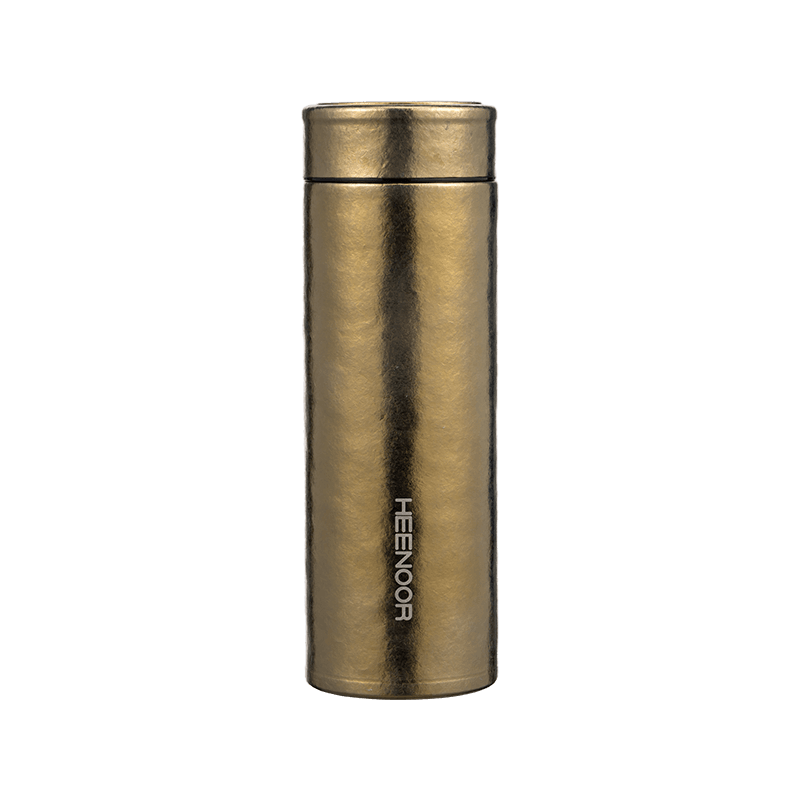
Pure Titanium Business Vacuum Flask
2. Double-Wall Vacuum Insulation and Temperature Retention
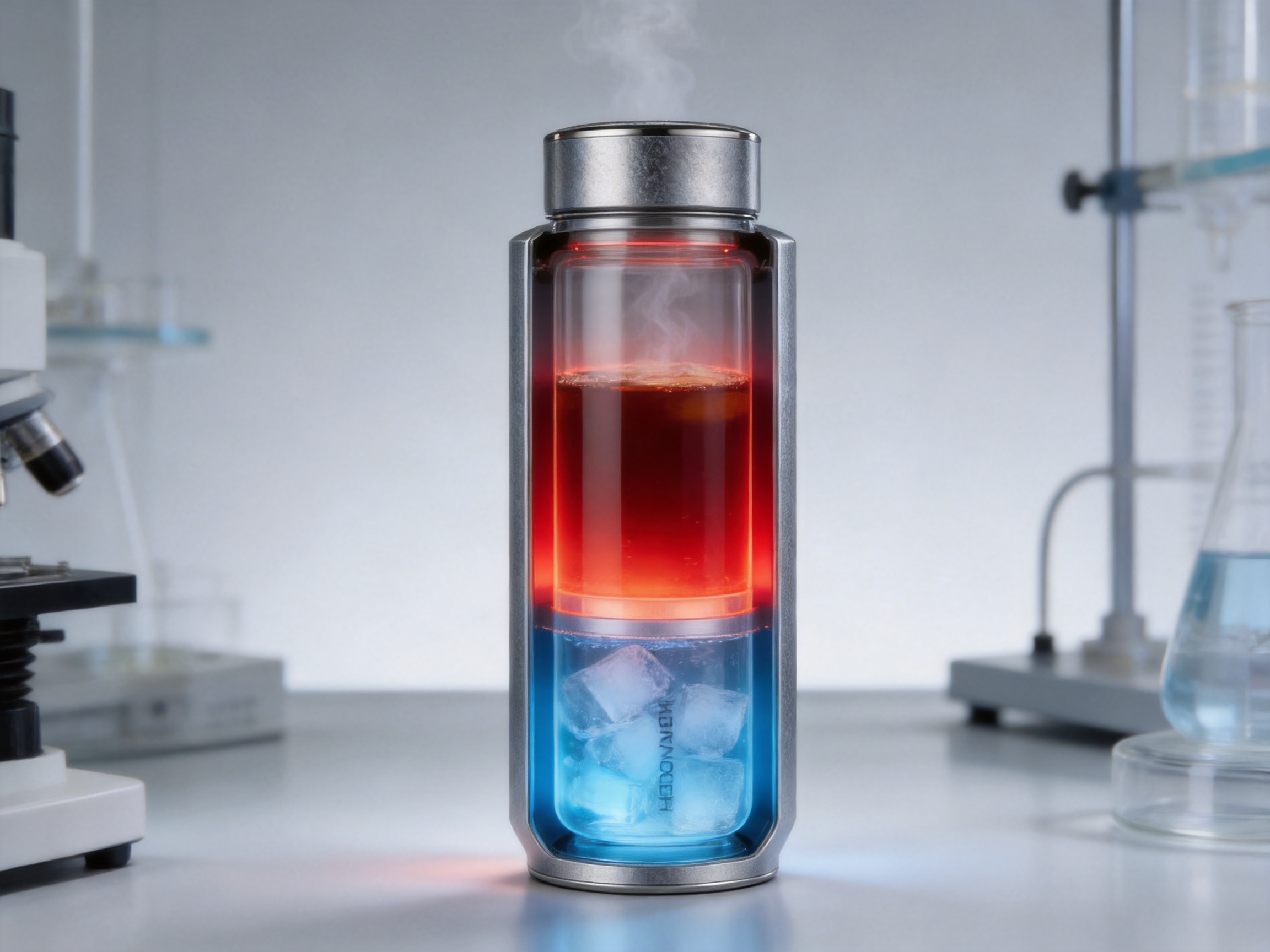
Material safety is only one part of a flask’s performance. The central purpose of a vacuum flask is to slow the movement of heat between the beverage and the surrounding environment. The Pure Titanium Business Vacuum Flask uses a double-wall vacuum structure designed to reduce heat transfer through conduction and convection.
In a conventional single-wall container, heat can move relatively easily through the wall. A hot beverage gradually warms the outside surface and loses energy to the surrounding air. A cold beverage receives heat from the environment. A double-wall construction creates an insulating space between the inner and outer walls. When much of the air is removed from this space, convection is greatly reduced, and the remaining pathways for heat transfer become more limited.
Radiation and conduction through structural connection points cannot be eliminated entirely, but careful engineering can reduce their effect. Wall thickness, neck geometry, base construction, sealing, and the quality of the vacuum process all contribute to the final result. The lid is also important because it represents a potential path for heat exchange. A well-designed inner lid and properly fitted sealing components help preserve the thermal performance of the entire system.
2.1 Reported Hot Beverage Performance
According to the product information, when the surrounding temperature is approximately 25 degrees Celsius and 95-degree Celsius hot water is poured into the flask, the water temperature remains approximately 62.3 degrees Celsius after six hours and approximately 47.5 degrees Celsius after twelve hours.
These figures indicate that the flask is intended for extended use rather than short-term beverage storage only. A user can fill the bottle in the morning and still have a warm beverage during the working day. The exact result in practical use will vary according to the initial fill temperature, beverage volume, lid-opening frequency, ambient temperature, wind exposure, and the temperature of the flask before filling.
The performance data should therefore be understood as controlled reference information rather than an absolute guarantee for every situation. Even so, the reported temperature values provide a useful indication of the product’s insulation capability and its suitability for office work, travel, business meetings, outdoor activities, and long-distance commuting.
2.2 Reported Cold Beverage Performance
When 0-degree Celsius ice water is added under an ambient temperature of approximately 25 degrees Celsius, the product information states that the water temperature is about 12.3 degrees Celsius after six hours and approximately 6.3 degrees Celsius after twelve hours.
Cold retention is important for users who carry chilled water, iced tea, fruit beverages, sports drinks, or other cold refreshments. The double-wall vacuum system slows the entry of heat from the surrounding environment, helping the beverage remain cooler for longer than it would in a single-wall metal or plastic bottle.
The ability to retain both heat and cold makes the flask versatile across seasons. It can be used for hot drinks during winter commuting and outdoor activities, then used for cool water or iced beverages during summer travel. This flexibility improves product utilization and can make a premium flask more valuable than a container designed for only one temperature range.
2.3 Reliability in Different Environments
Titanium maintains good strength and stability across a broad range of temperatures. This is one reason it is associated with demanding technical applications. In drinkware, the benefit is practical: the material system is intended to remain dependable when the flask is used in cold outdoor conditions, warm climates, or changing environments.
The product information refers to reliable performance in settings ranging from extremely cold polar conditions to hot equatorial environments. Actual thermal retention will always depend on external conditions, but the titanium body and vacuum structure provide a strong foundation for broad environmental use.
For professional users, this environmental adaptability can be valuable. Field personnel, outdoor professionals, travelers, construction teams, drivers, and event staff may use the same flask in changing climates. A product that remains lightweight while offering both hot and cold retention can reduce the need to carry separate containers for different seasons or applications.
2.4 Thermal Performance Depends on the Complete Design
It is important to evaluate a vacuum flask as a complete system rather than focusing only on the vacuum layer. Thermal efficiency depends on the relationship between the inner wall, outer wall, neck, lid, sealing ring, base, and opening mechanism.
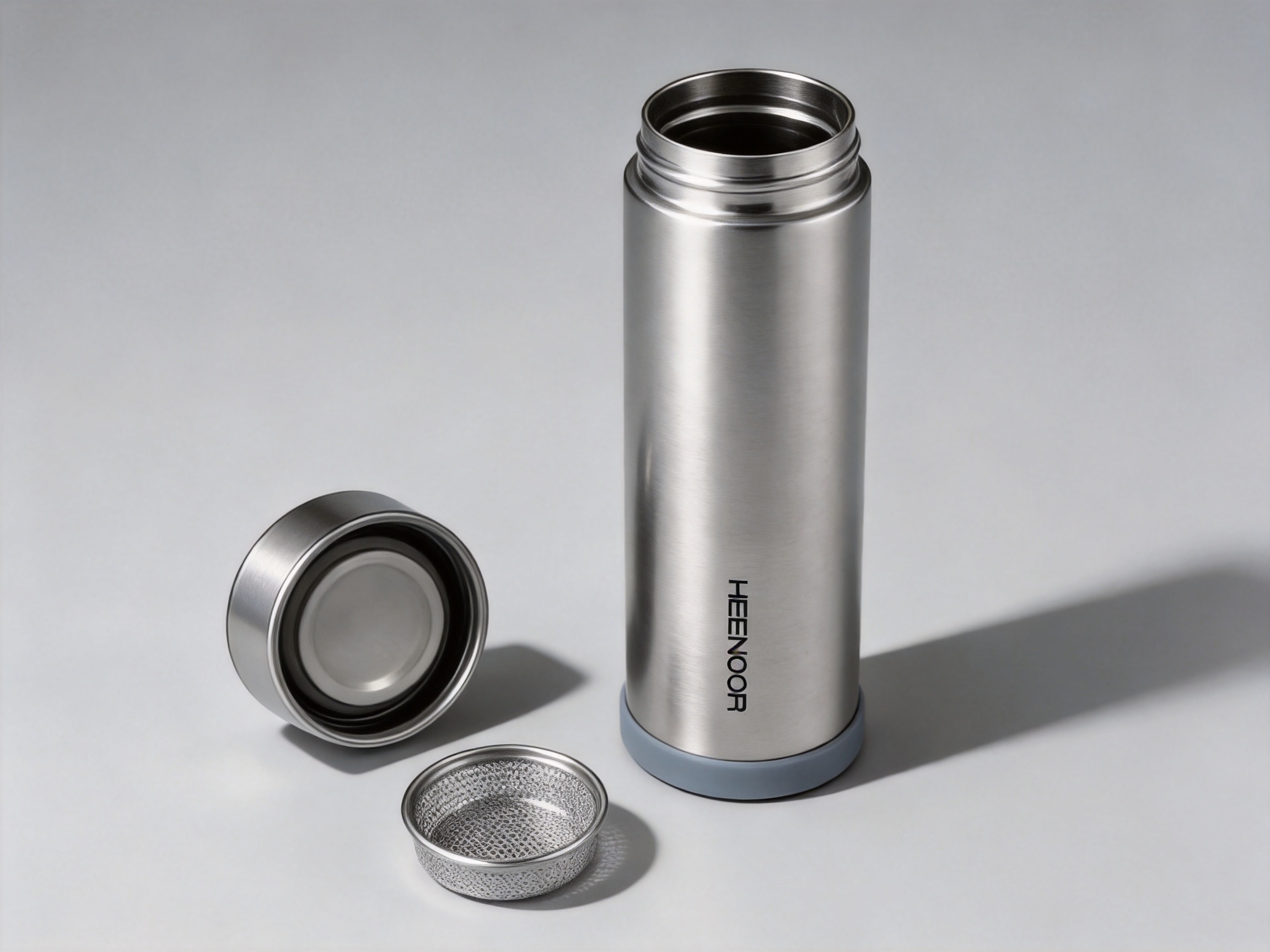
The inner lid and filter in this product are made from high-purity titanium. This helps maintain the premium material concept in areas that come into contact with the beverage. The fit between the lid and the bottle mouth also affects heat retention. A poorly fitting lid can allow heat to escape or warm air to enter, reducing the benefit of the vacuum body.
The mouth is rounded and thickened. This design supports comfortable drinking, but it also provides a stable structural area for lid engagement and sealing. A carefully engineered mouth can improve usability while supporting the overall thermal system.
3. Structural Design and Everyday User Experience
A premium flask should be easy to carry, comfortable to drink from, stable when placed on a desk or outdoor surface, and simple to maintain. The Pure Titanium Business Vacuum Flask incorporates several design details intended to support these daily requirements.
3.1 Lightweight Construction
The product is described as lighter than mainstream smartphones. This is a meaningful benefit for users who carry a flask in a handbag, backpack, briefcase, travel case, or jacket pocket. Weight matters especially when a bottle is filled with water, because the beverage itself already contributes substantial mass.
A lightweight empty flask allows users to carry more liquid without making the total load unnecessarily burdensome. This is valuable for business travelers, commuters, hikers, students, and people who spend long periods away from a kitchen or water dispenser.
Light weight can also improve customer acceptance in promotional and corporate gift programs. A product that looks premium but is uncomfortable to carry may be used infrequently. By contrast, a light and compact flask is more likely to become part of the user’s normal routine, increasing the practical value of the product and the visibility of the purchasing organization’s gift or brand program.
3.2 Rounded and Thickened Mouth
The bottle mouth is rounded and thickened to create a more comfortable drinking experience. The shape of the mouth is easy to overlook, but it influences how naturally users can drink directly from the flask, how the lid feels when opened, and how the opening withstands repeated use.
A rounded edge reduces the sharp or unfinished sensation that can occur on low-quality metal containers. A thicker mouth can also provide a stronger interface for the inner lid and help the bottle maintain its shape during regular handling. For users who drink directly from the bottle, this small design detail can make a noticeable difference over time.
3.3 Silicone Base Ring
A silicone ring is fitted at the base of the flask to support steady placement and slip resistance. The ring helps the bottle remain stable on desks, counters, tables, and other relatively smooth surfaces. It also creates a buffer between the titanium base and the surface below, which can reduce noise during placement and help protect both the flask and furniture from direct contact.
The silicone ring contributes to everyday confidence. A lightweight flask should not feel unstable simply because it is light. A properly designed base can improve balance and reduce the likelihood of accidental movement when the bottle is placed near documents, computers, or other work equipment.
3.4 Natural Anodized Color
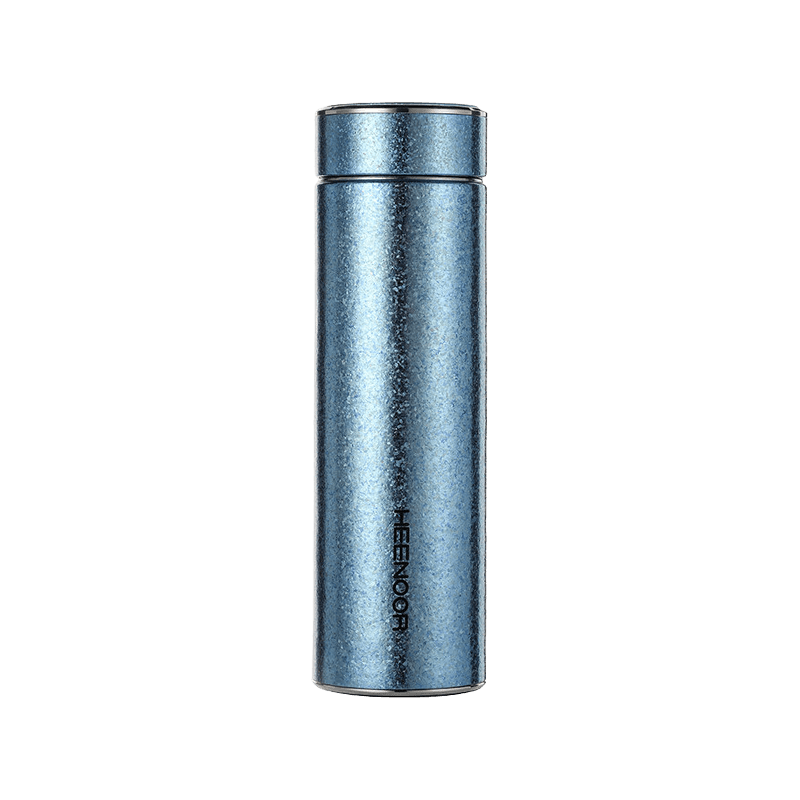
The bottle body uses anodizing technology to display natural colors without a conventional paint coating. Anodizing changes the surface characteristics of the titanium through an electrochemical process rather than applying a separate layer of paint. The result can provide a refined metallic appearance while preserving the visual identity of the underlying material.
This approach offers several potential advantages for premium drinkware. It supports a clean, integrated look and can provide a distinctive color palette for personal or corporate use. It also avoids the visual effect of a thick external paint layer that may conceal the metal’s natural character.
As with any surface treatment, the final durability depends on process control, handling, and exposure conditions. However, the use of anodizing aligns well with the product’s premium titanium positioning and helps differentiate it from ordinary painted stainless steel bottles.
4. Manufacturing Process and Engineering Capabilities
A premium titanium vacuum flask requires specialized manufacturing control because titanium behaves differently from many conventional drinkware materials. Its forming, joining, finishing, cleaning, and surface-treatment requirements must be managed carefully. The quality of the final flask depends on the coordination of product design, material sourcing, tooling, production, inspection, and packaging.
The manufacturer behind this product was founded in 1999 and has developed extensive experience in drinkware product development and industrial manufacturing. Its capabilities cover product design, engineering validation, tooling development, standardized production, and quality management. This integrated structure is important for buyers seeking stable supply rather than a one-time prototype.
4.1 Product Design and Application Analysis
Manufacturing quality begins before the first piece of metal is cut. Product designers must consider the intended capacity, user group, lid structure, filter requirements, center of gravity, thermal targets, cleaning needs, surface finish, and packaging limitations.
For a business-oriented vacuum flask, the design must balance a professional appearance with practical daily use. The bottle should look refined in an office or meeting environment while remaining suitable for travel and outdoor use. The rounded mouth, lightweight body, silicone base ring, and natural anodized color all reflect this balance between business presentation and functional portability.
Design teams also need to consider manufacturability. A shape that looks attractive in a digital model may be difficult to form, weld, clean, inspect, or package consistently. An experienced manufacturer evaluates these issues during engineering development so that the final product can be produced in stable volume rather than only as a small batch.
4.2 Engineering Validation
Engineering validation helps determine whether the proposed design can meet performance expectations. For a vacuum flask, validation may include dimensional checks, leakage testing, vacuum integrity testing, thermal retention testing, lid cycle testing, surface inspection, and compatibility checks for beverage-contact components.
The purpose of validation is not simply to confirm that a sample works once. It is to identify potential weaknesses and establish repeatable parameters. For example, the relationship between wall geometry and vacuum performance must be confirmed. The lid must remain secure without being excessively difficult to open. The silicone base ring must fit consistently. The anodized color must meet the required visual standard across production batches.
Validation is particularly important for titanium products because material cost is higher than that of many mainstream drinkware materials. Effective engineering can reduce waste, minimize rework, improve yield, and protect the long-term economics of the program.
4.3 Tooling Development
Tooling influences the repeatability of forming and assembly. Accurate tools help control the bottle’s dimensions, mouth geometry, base structure, and component fit. In a vacuum flask, small dimensional variations can affect sealing, balance, lid engagement, and thermal performance.
Integrated tooling development allows the manufacturer to adjust the tools according to the chosen titanium grade, wall thickness, product shape, and production volume. This is especially valuable for customized projects in which a customer requires a particular capacity, logo area, lid configuration, or body profile.
Well-developed tooling also supports consistent appearance. When the body shape is repeated accurately, the anodized surface can present a more uniform visual result. In premium drinkware, visual consistency is important because color variation, uneven edges, or inconsistent gaps can reduce the perceived value of the entire product.
4.4 Standardized Production
Standardized production transforms engineering requirements into repeatable factory operations. Standard operating procedures help define how materials are received, formed, cleaned, assembled, vacuum processed, surface treated, inspected, and packed.
For titanium drinkware, standardized production may address material identification, contamination control, forming parameters, joining conditions, surface preparation, anodizing settings, and final cleaning. Each stage contributes to the finished product. A good raw material can still produce an unsatisfactory flask if the surface is contaminated, the vacuum is inadequate, the lid fit is inconsistent, or the anodized color varies significantly.
Standardization also supports predictable delivery. International customers often require a stable product over multiple orders. They may need to coordinate marketing campaigns, retail launches, corporate events, or annual procurement programs. A manufacturing partner with documented processes and quality management is better positioned to maintain product consistency across repeated production cycles.
4.5 Quality Management
Quality management should cover the entire manufacturing chain rather than relying only on final inspection. Incoming material checks, process controls, operator guidance, in-process inspection, finished-product testing, and traceability all contribute to dependable quality.
For this product category, relevant quality points may include:
• Verification of titanium material identity and purity specifications.
• Inspection of body dimensions, wall geometry, mouth shape, and base stability.
• Checking the fit and function of the inner lid and filter.
• Leakage and sealing tests for the assembled flask.
• Vacuum integrity and thermal retention checks.
• Inspection of anodized color, surface uniformity, and visible defects.
• Verification of silicone base-ring placement and adhesion or fit.
• Cleaning and packaging checks before shipment.
These controls support the product’s premium positioning and help reduce variation between units. They also provide buyers with a clearer framework for supplier evaluation and incoming quality inspection.
4.6 Experience Across Multiple Drinkware Materials
The manufacturer works with stainless steel, titanium, plastic, and glass drinkware. Experience across these materials supports a broad understanding of how material properties affect design, production, cost, and end-user requirements.
Stainless steel experience can contribute to knowledge of vacuum flask construction and high-volume metal forming. Titanium experience supports the development of lightweight premium products. Plastic expertise can assist with accessory, sealing, and packaging components. Glass experience broadens the company’s understanding of transparent beverage products and material-specific quality control.
This multi-material capability is valuable to brands and procurement teams that manage several product categories. Instead of coordinating with unrelated suppliers for every type of drinkware, a customer may be able to develop a broader portfolio with one experienced manufacturing partner.
5. Advantages for Brands, Distributors, and Procurement Teams
The product’s value extends beyond its physical specifications. For commercial buyers, the quality of the manufacturing relationship can be just as important as the bottle itself.
5.1 A Clear Premium Product Story
The Pure Titanium Business Vacuum Flask has a straightforward product narrative: high-purity titanium, double-wall vacuum insulation, natural anodized color, lightweight construction, and refined usability. These features are easy to communicate to customers and suitable for premium retail, business gifts, corporate programs, outdoor equipment, and specialty drinkware collections.
A clear material story can help a product stand out in a crowded market. Many vacuum flasks have similar shapes and basic insulation claims. Titanium provides a stronger point of differentiation because it is associated with lightness, corrosion resistance, durability, and technical performance.
5.2 Suitability for Corporate and Business Use
The professional appearance of the flask makes it suitable for corporate gifting, conference programs, executive gifts, client appreciation, employee recognition, and institutional procurement. The anodized natural color can support a refined appearance without relying on a fragile paint coating.
Business users also benefit from the practical combination of lightweight construction and thermal retention. The flask can accompany a user through meetings, travel, commuting, and working hours while maintaining a polished appearance.
5.3 Support for Premium and Outdoor Markets
The product can also serve premium outdoor and travel markets. Outdoor users often value low weight, durability, temperature retention, and resistance to changing environmental conditions. Titanium’s material identity is especially appealing to consumers who purchase technical equipment and are willing to invest in long-term, high-performance products.
For retailers, the flask can occupy a position between ordinary mass-market drinkware and highly specialized expedition equipment. It has the premium material and technical features expected by demanding buyers while maintaining a practical design suitable for everyday use.
5.4 Long-Term Supply Stability
Product development and production integration can help improve supply stability. A manufacturer that can manage design, tooling, validation, production, and quality internally may respond more efficiently to engineering changes and production requirements than a supplier that relies heavily on disconnected subcontractors.
Long-term supply stability is particularly important for customers who need repeat orders. A product may be launched in one season and then replenished for several years. Consistent tooling, documented specifications, controlled material sourcing, and established inspection procedures can help preserve the original product standard.
6. Practical Use and Care Considerations
Even a technically advanced flask benefits from responsible use. Users should clean the bottle regularly, rinse it after beverages with strong flavors or pigments, and follow the manufacturer’s care instructions for the lid, filter, silicone ring, and interior surfaces.
When switching between beverages, thorough cleaning helps maintain flavor neutrality. Tea, coffee, milk-based drinks, juices, and herbal beverages may leave different residues. Prompt rinsing is especially useful when the bottle is not going to be washed immediately.
The lid should be closed securely during transport, and the flask should be checked for leakage before being placed in a bag with electronic equipment or important documents. Users should also avoid treating a vacuum flask as indestructible. Although titanium is strong and stable, severe impact can damage the shape, lid fit, surface finish, or vacuum structure.
For hot beverages, users should handle the flask carefully because the contents may remain hot for many hours. The outside may feel relatively comfortable to hold due to the insulation, but the beverage itself can still cause burns if consumed immediately after filling.
For cold beverages, condensation is generally reduced by the insulated double-wall structure, but moisture may still appear around the lid or exposed areas under certain environmental conditions. Keeping the lid and sealing components clean helps preserve both hygiene and function.
7. Product Positioning and Competitive Differentiation
The strongest competitive advantage of this flask is the combination of features rather than any single specification. High-purity titanium supports material safety and corrosion resistance. The double-wall vacuum structure provides hot and cold retention. Lightweight construction improves portability. Anodized color provides a premium appearance without a conventional paint coating. The rounded mouth and silicone base ring improve daily usability.
Many competing products may offer one or two of these features, but fewer combine them in a coherent premium product. A stainless steel flask may provide excellent insulation but weigh more. A plastic bottle may be lighter but lack high-temperature capability and premium durability. A glass bottle may provide a neutral interior but be more fragile. A painted metal flask may offer color but rely on an external coating that can show wear.
The titanium flask therefore appeals to buyers who do not want to make a single compromise between lightness, safety, appearance, and thermal function. It is designed as a balanced premium product for users who expect both technical performance and refined presentation.
| Product Attribute | Customer Benefit | Commercial Significance |
|---|---|---|
| Industrial pure titanium exceeding 99.6% purity | Premium beverage-contact material with strong corrosion resistance | Supports health-focused and high-value product positioning |
| Double-wall vacuum structure | Helps retain hot and cold beverage temperatures | Suitable for year-round use and multiple market segments |
| Natural anodized color | Distinctive appearance without conventional paint coating | Useful for premium retail and corporate gift programs |
| Lightweight body | Improves carrying comfort | Attractive to travelers, commuters, and outdoor users |
| Rounded, thickened mouth | Enhances drinking comfort and structural refinement | Improves perceived quality and user satisfaction |
| Silicone base ring | Provides stability and slip resistance | Supports safer use in offices, vehicles, and outdoor settings |
| Integrated product development and manufacturing | Supports consistent quality and engineering response | Valuable for repeat orders and customized programs |
8. Why Manufacturing Discipline Matters
Product specifications are meaningful only when they can be reproduced consistently. A single high-performing sample does not guarantee that every unit in a production batch will perform in the same way. This is why manufacturing discipline is central to the value of the Pure Titanium Business Vacuum Flask.
Material identification must be controlled so that the specified titanium is used throughout the required components. Forming and assembly must be repeatable so that the body, mouth, lid, filter, and base maintain the intended dimensions. Vacuum processing must be stable so that thermal performance does not vary widely between units. Anodizing must be controlled so that the color and finish remain consistent. Final inspection must detect leakage, surface defects, poor fit, and other problems before shipment.
An experienced manufacturer can organize these requirements into a practical production system. The company’s long history in drinkware manufacturing, combined with its capabilities in design, engineering validation, tooling, standardized production, and quality management, provides a foundation for delivering dependable products at commercial scale.
This is particularly important for international customers. A procurement team may need clear specifications, production samples, quality documentation, packing requirements, and delivery coordination. A manufacturing partner that understands the full project cycle can help reduce communication gaps and improve execution from early development through final shipment.
9. Suitable Application Scenarios
9.1 Office and Business Travel
The flask’s professional appearance, lightweight body, and long thermal retention make it suitable for office workers, managers, consultants, sales teams, and business travelers. It can hold water, coffee, tea, or other common beverages during meetings, commuting, and travel.
9.2 Outdoor Recreation
Hiking, camping, sightseeing, cycling, and other outdoor activities often require a container that is light, durable, and capable of preserving beverage temperature. Titanium construction and a silicone base ring support this type of use, while the compact form can reduce the burden of carrying hydration equipment.
9.3 Corporate Gifts and Promotional Programs
A high-purity titanium flask can serve as a premium corporate gift. Its useful daily function gives it a longer practical life than many novelty items. The product can also provide a suitable base for carefully planned customization, subject to technical evaluation of the desired logo, packaging, color, and order quantity.
9.4 Premium Retail Collections
Specialty retailers can position the product within collections focused on titanium equipment, technical travel accessories, sustainable daily-use products, or high-end drinkware. The combination of natural color, lightweight construction, and insulation gives the flask a strong story for product displays and online catalogs.
9.5 Institutional and Professional Procurement
Organizations purchasing drinkware for staff, events, field teams, hospitality programs, or client packages may value the product’s material specifications and manufacturing support. The flask can be evaluated as part of a broader drinkware program that includes stainless steel, glass, plastic, and titanium items.
10. Frequently Asked Questions
Q1: What material is used for the bottle body?
The bottle body is made from industrial pure titanium with a stated purity exceeding 99.6%. The inner lid and filter are also specified as industrial pure titanium.
Q2: Is the flask suitable for beverages other than water?
Yes. The product is designed for common beverages such as tea, coffee, milk, fruit juice, and traditional herbal drinks. Titanium forms a stable oxide film in air and is resistant to corrosion under ordinary room-temperature conditions. Users should still clean the flask promptly after use and follow care instructions for specific beverages.
Q3: Does the flask contain lead, cadmium, or arsenic?
The product information states that third-party test reports found no detectable lead, cadmium, or arsenic. Buyers requiring formal compliance documentation should request and review the applicable test reports for the specific production model and market.
Q4: How well does it retain hot water?
Under the stated reference conditions of approximately 25 degrees Celsius ambient temperature, 95-degree Celsius hot water remains at approximately 62.3 degrees Celsius after six hours and approximately 47.5 degrees Celsius after twelve hours. Actual results vary according to filling volume, opening frequency, ambient conditions, and usage.
Q5: How well does it retain cold water?
When 0-degree Celsius ice water is added under the stated conditions, the water temperature is approximately 12.3 degrees Celsius after six hours and approximately 6.3 degrees Celsius after twelve hours. These figures are reference values, and actual performance depends on use conditions.
Q6: What is the purpose of the double-wall vacuum structure?
The double-wall vacuum structure reduces heat transfer through conduction and convection. This helps slow the loss of heat from hot beverages and the entry of heat into cold beverages.
Q7: Does the bottle use paint for its color?
The product uses anodizing technology to create natural colors without a conventional paint coating. This gives the bottle a refined metallic appearance and supports its premium titanium identity.
Q8: Is the flask heavy to carry?
The product is described as lighter than mainstream smartphones. Its lightweight construction is intended to reduce carrying burden, especially when the flask is placed in a backpack, briefcase, handbag, or travel case.
Q9: What is the function of the silicone ring at the bottom?
The silicone ring helps the flask stand steadily and improves slip resistance. It also provides a buffer between the base of the flask and the surface on which it is placed.
Q10: Is the mouth comfortable for direct drinking?
The bottle mouth is rounded and thickened to provide a more comfortable drinking feel. The shape also contributes to a refined user experience and supports the lid interface.
Q11: Is the flask suitable for outdoor use?
Yes. Its lightweight construction, vacuum insulation, titanium material, and stable base make it suitable for travel, commuting, hiking, camping, and other outdoor activities. Users should still protect the flask from severe impact and follow normal care practices.
Q12: Can the product be customized for brands or organizations?
The manufacturer supports product development and industrial manufacturing programs. Potential customization may include product details, surface appearance, packaging, or branding, depending on technical feasibility, order quantity, tooling requirements, and project specifications.
Q13: What manufacturing capabilities support the product?
The manufacturer integrates product design, engineering validation, tooling development, standardized production, and quality management. It also has experience working with stainless steel, titanium, plastic, and glass drinkware.
Q14: Why is titanium advantageous compared with ordinary stainless steel?
Titanium can provide a lower-weight premium metal construction, strong corrosion resistance, a distinctive technical appearance, and a stable beverage-contact surface. Stainless steel remains an effective and economical material, but titanium is attractive when portability and premium differentiation are priorities.
Q15: What should buyers request before placing a large order?
Buyers should confirm material specifications, product drawings, capacity, thermal test conditions, surface-color requirements, packaging, inspection standards, available customization, production lead time, and applicable safety or compliance documentation.
11. Conclusion
The Pure Titanium Business Vacuum Flask is designed for buyers who expect more than basic beverage storage. Its high-purity titanium bottle body, inner lid, and filter provide a premium material platform with strong corrosion resistance and a stable beverage-contact surface. Its double-wall vacuum structure supports extended hot and cold retention, while the lightweight body improves portability.
Design details such as the rounded and thickened mouth, silicone base ring, and natural anodized color improve the product’s daily usability and visual identity. Together, these features distinguish the flask from ordinary painted stainless steel bottles, plastic containers, and fragile glass alternatives.
The product’s commercial value is further strengthened by the manufacturer’s integrated capabilities. Experience in product design, engineering validation, tooling development, standardized production, and quality management supports reliable large-volume manufacturing. Experience across stainless steel, titanium, plastic, and glass drinkware also provides a broad foundation for customized product programs and multi-category supply.
For business users, outdoor consumers, premium retailers, corporate procurement teams, and international brands, the flask offers a balanced combination of material purity, thermal performance, light weight, refined appearance, and manufacturing reliability. It is a practical example of how advanced material selection and disciplined industrial production can work together to create a durable, premium drinkware product.
References
1. Product technical information for the Pure Titanium Business Vacuum Flask, including material composition, thermal-retention data, structural design, and surface-treatment details.
2. General technical literature on titanium passivation, oxide-film formation, and corrosion resistance in ordinary atmospheric environments.
3. General engineering references on double-wall vacuum insulation, heat conduction, convection, and thermal-retention testing for portable drinkware.
4. General materials references concerning industrial pure titanium, material stability, and beverage-contact applications.
5. General quality-management references for metal forming, tooling development, surface treatment, assembly inspection, and standardized drinkware production.
6. Third-party material and heavy-metal test information cited in the product specifications.
Product: Pure Titanium Business Vacuum Flask

You may also like…
Copyright © 2025 Heenoor Co., Ltd. All Rights Reserved.
 Custom Stainless Steel Drinkware Manufacturers
BACK TOP