 English
 中文简体
中文简体 日本語
日本語 Español
 عربى
عربى
Search
Categories
Recommend
Categories
 Lin Yuxi — International Product Sales Manager
Recommend
-
 Industry news
 -
 Industry news
 -
 Industry news
 -
 Industry news
Sep 04, 2026 - By admin
Elegant Jade-Style Vacuum Flask: Material Innovation, Refined Design, and Reliable Manufacturing
Content
- 1 A Premium Vacuum Flask Built Around Material Selection
- 2 Vacuum Insulation for Everyday Beverage Use
- 3 A Distinctive Jade-Inspired Design Language
- 4 Natural Calcite Jade as a Premium Lid Element
- 5 Functional Filter Design and Cleaning Convenience
- 6 Ergonomic Form and Everyday Portability
- 7 Packaging with Cultural and Gifting Value
- 8 Manufacturing Strengths Behind the Product
- 9 Advantages over Conventional Competitor Products
- 10 Applications Across Consumer and Commercial Markets
- 11 Quality, Durability, and Long-Term Product Value
- 12 Manufacturing Partnership for Custom Drinkware Programs
- 13 Product Care and Responsible Use
- 14 Frequently Asked Questions
- 14.1 What is the capacity of the elegant jade-style vacuum flask?
- 14.2 What material is used for the inner liner?
- 14.3 What beverages can be stored in the flask?
- 14.4 Does the flask include a filter?
- 14.5 What makes the lid different from a conventional vacuum flask lid?
- 14.6 Is the jade element natural?
- 14.7 What is the design inspiration behind the product?
- 14.8 What type of packaging is included?
- 14.9 What are the dimensions of the two models?
- 14.10 What advantages does this product have over a standard stainless steel bottle?
- 14.11 Who manufactures the vacuum flask?
- 14.12 What manufacturing capabilities does the company provide?
- 14.13 Can the product be considered for corporate gifting?
- 14.14 How should the flask be cleaned?
- 15 Conclusion
- 16 References
- 17 Product: Elegant Jade-style Vacuum flask
The elegant jade-style vacuum flask is a premium stainless steel drinkware product created for consumers and organizations seeking more than basic beverage storage. It combines corrosion-resistant stainless steel, a carefully developed vacuum-insulated structure, natural calcite jade, a removable filter, and a culturally inspired design language. The result is a practical drinking vessel with the appearance and emotional value of a refined gift item.
At the center of the product is a carefully balanced approach to functionality and aesthetics. The cup is designed to hold tea, coffee, milk, and other everyday beverages safely, while its compact form supports convenient carrying and comfortable use. Its use of a 316L stainless steel inner liner provides a strong foundation for beverage contact, while the 304 stainless steel cup body and lid components contribute to structural durability and manufacturability.
The product is also positioned as a differentiated alternative to ordinary vacuum flasks. Many competing bottles focus primarily on thermal insulation, capacity, or exterior color. This model adds a distinct material story through the use of natural calcite jade in the lid, a pearlescent jade-toned finish on the body, and a design concept influenced by traditional Chinese appreciation of jade. It is therefore suitable not only for personal use, but also for premium corporate gifts, cultural merchandise, hospitality programs, and carefully curated retail collections.
A Premium Vacuum Flask Built Around Material Selection
Material selection is one of the most important factors in the performance and perceived quality of a vacuum flask. A container may have an attractive appearance, but its practical value depends on whether its internal materials are suitable for repeated beverage contact, whether its structural components can withstand daily use, and whether the lid and filter can be cleaned effectively.
This vacuum flask uses a combination of 304 and 316L stainless steel. The cup body is made with 304 stainless steel, while the inner liner is specifically made from 316L stainless steel. This combination allows the product to balance strength, corrosion resistance, production practicality, and premium positioning.
316L stainless steel is widely valued for its strong corrosion resistance. That characteristic is particularly relevant to drinkware because beverages may contain acids, salts, oils, tannins, or dairy components. Tea, coffee, fruit-based drinks, and milk can all create different cleaning and material-contact demands. A 316L inner liner offers a dependable material foundation for these daily applications when the product is used and maintained correctly.
The inner liner is also described as odorless, which is an important advantage for consumers who alternate between different beverages. Some inexpensive containers may retain traces of a previous drink, especially if they have difficult-to-clean seals, rough internal surfaces, or plastic components that absorb odors. The use of stainless steel in the beverage-contact structure helps support a cleaner sensory experience between uses.
In addition to the liner, the filter is constructed from 316L stainless steel and food-grade silicone rubber. This selection is useful for tea drinkers and other users who want to separate leaves, herbs, or larger particles from the beverage. Because the filter can be taken apart, users can access its components more easily during washing. This is a meaningful advantage over fixed or complicated filter assemblies that may trap residue in narrow spaces.
Why the 304 and 316L Combination Matters
Not every component of a vacuum flask has exactly the same functional requirement. The inner liner must prioritize beverage compatibility and corrosion resistance. The outer cup body must provide shape, strength, surface quality, and efficient manufacturing. The lid must accommodate sealing components, structural parts, and decorative elements. Using suitable grades for different components is therefore more rational than applying one material indiscriminately throughout the product.
The 304 stainless steel cup body provides a widely used foundation for durable drinkware. It supports a stable exterior structure and can be processed into a clean, modern form. The 316L inner liner adds a higher level of corrosion resistance at the location where the beverage is stored. Together, these materials create a practical division of functions: robust exterior construction with a premium internal beverage-contact surface.
The lid specification includes 304 stainless steel, 316L stainless steel, silicone rubber, PP, and natural jade. Each material contributes to a different requirement. Stainless steel supports structural durability, silicone rubber assists with sealing and contact flexibility, PP can be used for suitable lightweight internal components, and natural jade gives the lid its distinctive visual and tactile identity.
| Component | Specified Material | Primary Contribution |
|---|---|---|
| Cup body | 304 stainless steel | Structural strength, durable exterior construction, and manufacturability |
| Inner liner | 316L stainless steel | Corrosion resistance and suitable beverage-contact performance |
| Filter | 316L stainless steel and food-grade silicone rubber | Tea or particle separation, flexible contact, and easier disassembly for cleaning |
| Cup lid | 304 stainless steel, 316L stainless steel, silicone rubber, PP, and natural jade | Sealing, structural assembly, lightweight functional parts, and premium decoration |
This material architecture also supports product differentiation in a crowded market. A standard stainless steel bottle may be functional but visually interchangeable with many other products. By contrast, the present model communicates quality through both its specifications and its material narrative. The combination of stainless steel engineering and natural jade creates an identity that is more suitable for premium gifting and design-led retail.
Elegant Jade-style Vacuum flask
Vacuum Insulation for Everyday Beverage Use
The primary purpose of a vacuum flask is to help preserve beverage temperature for a practical period of time. The product description presents the lid and overall construction as delivering “just-right” heat retention: not excessively scalding hot and not too cool, but warm when needed. This positioning is especially relevant to consumers who drink tea, coffee, or warm water gradually rather than immediately after filling the container.
Temperature experience is not simply a matter of maximum heat retention. For many users, a beverage that remains dangerously hot for too long is less convenient than one that reaches a comfortable drinking temperature. The product’s design language therefore emphasizes controlled daily usability rather than exaggerated performance claims. It is intended to accompany normal routines, including commuting, office work, meetings, study, travel, and leisure.
The vacuum-insulated format also supports portability. With capacity options of 400 milliliters and 500 milliliters, the flask is sized for personal beverage consumption rather than bulk storage. These capacities can accommodate tea, coffee, water, or milk while remaining relatively compact for bags, desks, vehicles, and hospitality settings.
Two Capacities for Different Drinking Habits
The 400-milliliter option is suitable for users who prefer a compact, lighter container or who usually drink smaller quantities at a time. It may also work well for tea service, executive desk use, gift sets, and situations where portability is more important than maximum capacity.
The 500-milliliter option provides additional volume for users who spend longer periods away from a refill point. It can support a larger serving of coffee, tea, warm water, or another everyday beverage while maintaining the same design concept and material language.
Offering two capacities is advantageous for distributors and purchasing teams because it broadens the addressable market without requiring an entirely different product family. Retailers can present the two sizes as complementary choices. Corporate buyers can select the capacity that best matches their event, audience, or packaging budget. Brands can also use the smaller and larger versions for different channels or gift tiers.
| Version | Capacity | Container Dimensions | Potential Use Profile |
|---|---|---|---|
| XN-325L | 400 ml | 40 × 186 × 66 mm | Compact personal use, tea drinking, office desks, and premium gifting |
| XN-326L | 500 ml | 43 × 200 × 71 mm | Longer daily use, larger beverage servings, commuting, and travel |
The specified dimensions demonstrate that the two options are intentionally differentiated in both height and overall size. The variation allows users to choose a volume without abandoning the core appearance of the product. For a procurement program, this also makes it possible to serve multiple user preferences while preserving a consistent visual identity.
A Distinctive Jade-Inspired Design Language
The product’s most visible difference from ordinary vacuum flasks is its jade-inspired appearance. The design draws from the long-standing cultural appreciation of jade in the Song Dynasty and from the poetic image of “pillowing on flowing water and rinsing with stones.” Rather than applying a literal traditional ornament, the product interprets these ideas through proportion, material contrast, light, and restrained geometry.
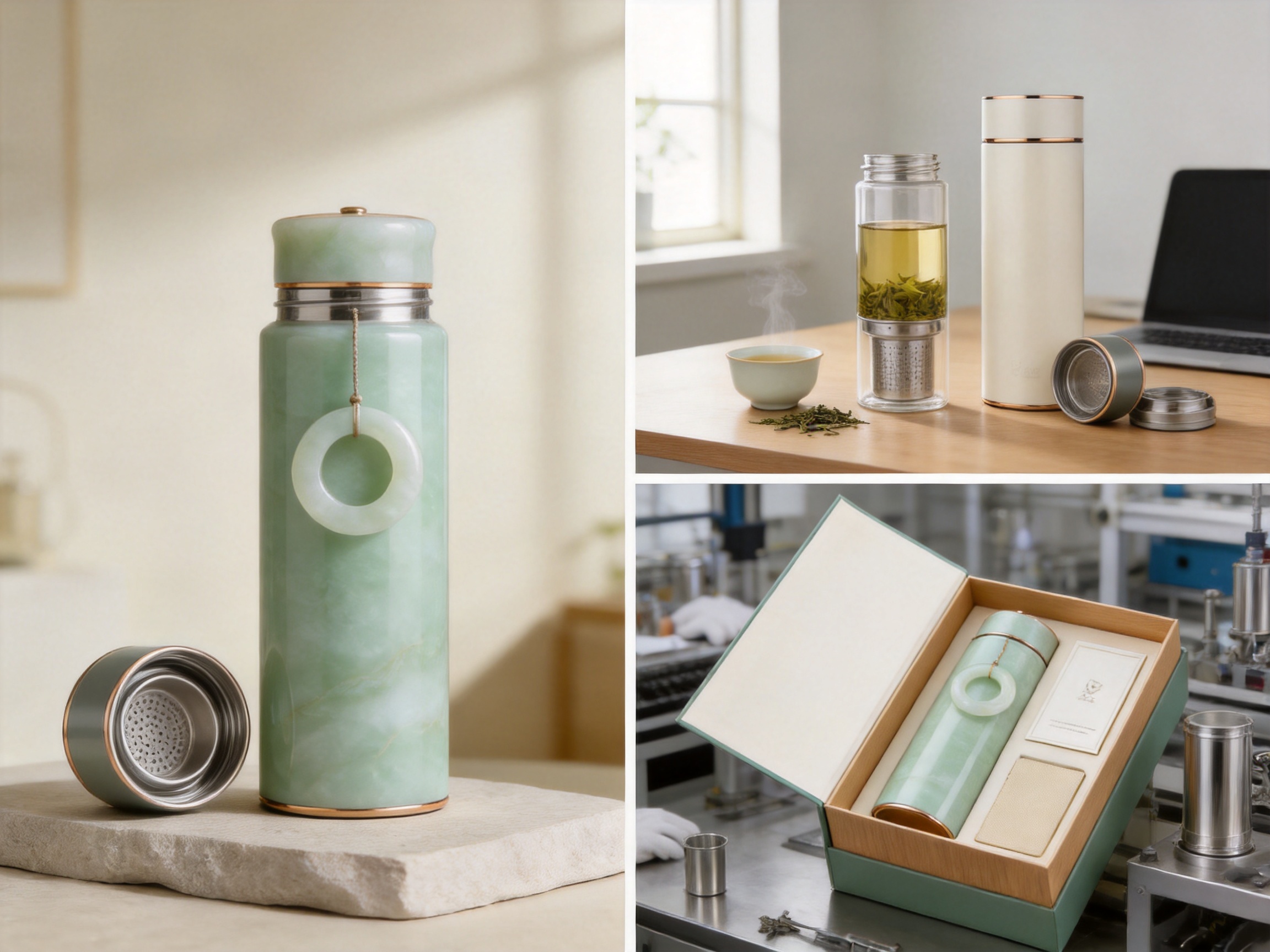
The lid features a ring-shaped jade wall suspended at the top. The circular form recalls the central opening of an ancient jade disc, while the floating arrangement creates visual separation between the jade element and the metal structure. This gives the lid a recognizable silhouette that can be identified from a distance and appreciated in close detail.
The logo is subtly placed within the ring-shaped form. This approach avoids excessive branding and allows the natural jade element and overall geometry to remain visually dominant. For premium products, understated identification can be more effective than a large printed mark. It gives the flask a more refined appearance and makes it suitable for environments where subtlety and taste are valued.
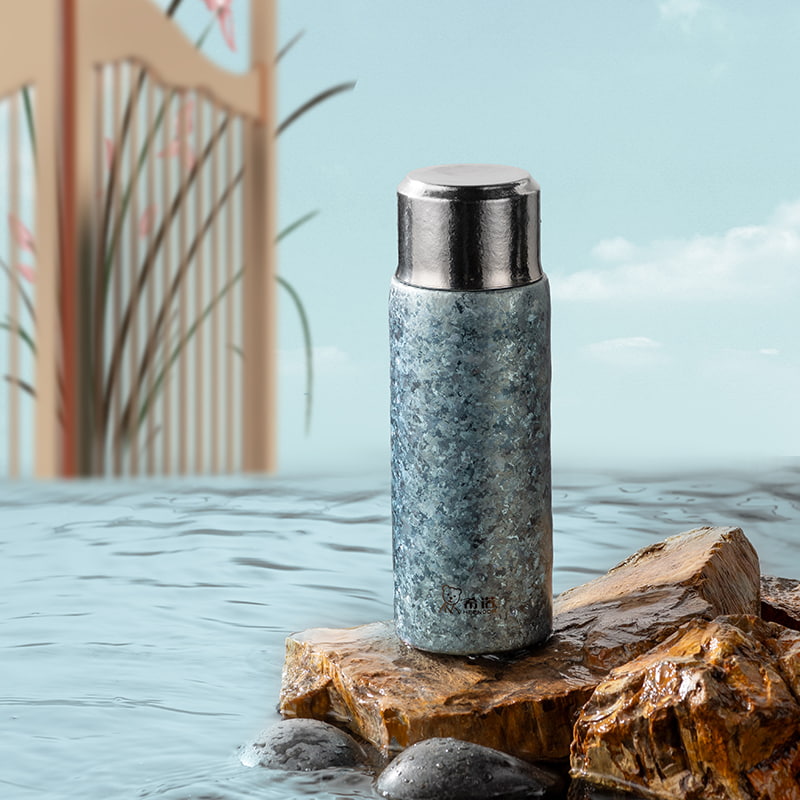
The body uses a pearlescent finish that shifts gently under changing light. Its jade-toned hue supports the cultural theme without attempting to imitate a specific gemstone pattern in an artificial or overly decorative way. The surface is intended to feel cool to the touch, creating a sensory connection between the user and the design concept.
Minimalism as a Competitive Advantage
Many decorative drinkware products rely on graphics, bright colors, large logos, or elaborate surface patterns to establish a premium appearance. Those approaches can be effective in some markets, but they may also limit product longevity or make the item difficult to use in professional settings. The jade-style flask takes a more restrained approach.
Its design is based on several controlled elements: the ring-shaped jade wall, the soft reflection of light, the pearlescent body, and the ergonomic grip. None of these elements needs to dominate the product. Their combined effect creates a calm, composed appearance that can appeal to consumers who prefer quiet luxury and culturally meaningful design.
This restraint provides several market advantages. First, it allows the product to function as both a personal accessory and a formal gift. Second, it reduces the risk that the appearance will be tied to a short-lived fashion trend. Third, it gives customization and packaging teams a clean visual foundation for coordinated branding, event presentation, or limited-edition programs.
The flask is therefore differentiated not only by the presence of natural jade, but also by the discipline with which that material is integrated. The jade is not an unrelated ornament attached to a generic bottle. It is connected to the product’s shape, story, tactile quality, and packaging concept.
Natural Calcite Jade as a Premium Lid Element
Natural calcite jade gives the lid an identity that ordinary stainless steel or plastic caps cannot easily reproduce. Each natural material has its own visual character, and subtle differences in tone or texture can make individual pieces feel more distinctive. In a premium product context, this individuality can increase the emotional value of the flask.
The use of jade also supports the product’s cultural positioning. Jade has long been associated with qualities such as refinement, integrity, composure, and enduring value in Chinese culture. The design draws on these associations without requiring the product to become ceremonial or impractical. The result is a contemporary item that can carry traditional references into daily life.
A gem and jade appraisal certificate is included in the gift box. This certificate functions as a material assurance and reinforces the commitment to using genuine, high-quality materials. For purchasers who are selecting gifts for clients, partners, employees, or important occasions, documentation can add confidence and make the product feel more complete.
The certificate is also valuable from a merchandising perspective. Retail staff can explain that the jade element is not simply a printed pattern or synthetic visual effect. Buyers can understand that the material story is supported by product documentation. This level of transparency is particularly useful in premium gifting, where perceived authenticity influences purchase decisions.
At the same time, natural jade requires appropriate handling. Users should avoid treating the decorative component as indestructible and should follow reasonable cleaning and care practices. The product’s premium value is best preserved through careful daily use, gentle cleaning, and protection from hard impacts.
Functional Filter Design and Cleaning Convenience
The integrated filter is an important feature for tea drinkers and users who prefer beverages with loose ingredients. Because the filter is made from 316L stainless steel and food-grade silicone rubber, it combines the rigidity required for filtering with the flexibility required for a stable fit and comfortable assembly.
A removable filter is generally more practical than a permanently enclosed filter. Tea leaves, herbal ingredients, and fine particles can accumulate during use. If a filter cannot be separated from the lid, cleaning may be incomplete, which can affect odor, appearance, and long-term hygiene. The ability to take the filter apart gives users better access to the individual surfaces.
Disassembly also supports inspection. Users can check whether residue remains around the filter edge, silicone contact points, or small openings. This is particularly helpful when the flask is used for milk-based beverages or sweetened drinks, which may require prompt and thorough cleaning.
Designed for Multiple Beverage Types
The product is described as suitable for daily beverages including tea, coffee, and milk. These beverages have different physical and sensory characteristics. Tea may contain leaves or sediment. Coffee may contain oils and fine grounds. Milk can leave a persistent film if it is not washed soon after use. A removable filter and stainless steel beverage-contact structure give the product a practical basis for handling this range of use cases.
Users should still follow basic care practices. The flask should be emptied after use, rinsed or washed promptly, and allowed to dry thoroughly with its components separated when appropriate. Sealing parts should be checked for residue, and the filter should be reassembled only after it is clean and dry. These habits help preserve the neutral taste and odor characteristics of the product.
For commercial buyers, cleanability is more than a consumer convenience. It can reduce complaints, support consistent user experience, and improve the perceived quality of the product over time. A drinkware item that is attractive at the time of purchase but difficult to maintain may quickly lose its value. The removable filter helps address this common weakness.
Ergonomic Form and Everyday Portability
A vacuum flask must be comfortable to hold, open, close, carry, and clean. The product description emphasizes an ergonomic grip as one of the key design elements. This suggests that the body shape was considered not only as a decorative surface but also as a functional interface between the user and the container.
The compact dimensions support use in everyday environments. The 400-milliliter version is approximately 186 millimeters in height, while the 500-milliliter version is approximately 200 millimeters in height. Their relatively narrow profiles can make them suitable for handbags, work bags, backpacks, and personal storage spaces, subject to the dimensions of the specific compartment.
The product’s visual balance is also important. A tall, narrow flask can communicate elegance, while a controlled diameter can make it easier to grip. The pearlescent surface and smooth jade-toned finish further support a refined tactile experience. Rather than appearing like industrial equipment, the flask is designed to feel like a personal object with a considered presence.
The lid is another major part of usability. It integrates multiple materials and must combine sealing performance, structural stability, decorative assembly, and ease of handling. The ring-shaped jade wall gives the user a recognizable point of interaction while distinguishing the opening area from the body. The lid’s design is therefore both a functional closure and a central visual feature.
Packaging with Cultural and Gifting Value
The gift box adopts a “heaven-and-earth cover” structure associated with the traditional concept of round heaven and square earth. Packaging is not treated as an afterthought; it forms part of the product’s meaning and presentation. This is especially relevant because the vacuum flask is suitable for formal gifting and premium merchandise programs.
The packaging concept communicates a wish that the recipient can maintain personal principles amid life’s changes and navigate social relationships with both integrity and flexibility. This interpretation gives the product a message that extends beyond temperature retention or material specifications. It transforms the flask into a thoughtful object with a clear symbolic purpose.
For businesses, the packaging can create value at several stages of the purchasing process. It improves the presentation at the moment of delivery, reduces the need for separate gift wrapping, and gives the recipient a context for understanding the design. It can also support seasonal campaigns, cultural events, executive gifts, and relationship-building programs.
A well-developed gift box also protects the product during handling and display. The exact protective performance depends on the final packaging configuration and logistics conditions, but a dedicated box generally supports better organization than unstructured packaging. The certificate can be included within the box as part of a complete product presentation.
Compared with a generic vacuum bottle placed in a standard carton, this presentation provides stronger differentiation. It combines product design, material authenticity, cultural interpretation, and delivery experience. That combination can help retailers and corporate buyers justify a premium position.
Manufacturing Strengths Behind the Product
The quality of a premium drinkware product depends on more than its concept. It requires reliable engineering, stable tooling, controlled production, careful assembly, and consistent quality management. Heenoor Co., Ltd. was founded in 1999 and has developed into a large-scale drinkware manufacturer specializing in product development and industrial manufacturing.
The company integrates product design, engineering validation, tooling development, standardized production, and quality management. This integrated structure is important because drinkware products often involve multiple interfaces: metal forming, vacuum construction, polishing or surface finishing, sealing, plastic molding, silicone components, filter assembly, decorative integration, and packaging.
When these activities are coordinated within a structured manufacturing system, design decisions can be evaluated against production requirements at an earlier stage. A visually attractive concept must still be suitable for tooling, assembly, inspection, cleaning, packaging, and long-term use. Engineering validation helps identify potential issues before volume production, while tooling development supports repeatable manufacturing.
Product Design and Engineering Validation
Product design is the first stage in transforming a concept into a manufacturable flask. For this jade-style model, the design challenge involves integrating an unusual natural material into a stainless steel lid while preserving the product’s overall balance. The ring-shaped jade wall must be compatible with the surrounding structure, and the lid must accommodate stainless steel, silicone rubber, PP, and jade components.
Engineering validation provides an opportunity to assess the relationship between these materials and the product’s intended use. Important considerations may include dimensional fit, component stability, sealing interfaces, assembly sequence, surface protection, and user interaction. The supplied company profile emphasizes engineering validation as part of its integrated capabilities, which supports a disciplined transition from design intent to production execution.
This capability is a competitive advantage compared with suppliers that rely primarily on catalog products or outsource disconnected stages of development. A manufacturing partner that can participate in engineering review is better positioned to support customized projects, design-led collections, and complex material combinations.
Tooling Development and Repeatability
Tooling has a direct influence on dimensional consistency, surface quality, assembly fit, and production efficiency. The body, lid, internal components, and packaging may each require dedicated tools or fixtures. A carefully developed tooling system allows the manufacturer to reproduce the approved design across larger quantities.
For a product with a distinctive ring-shaped lid, tooling accuracy is especially important. The visual appeal depends on the alignment and proportion of the jade element, metal structure, and logo placement. Small inconsistencies can affect the perceived quality of a premium product. Stable tooling helps control these relationships throughout a production run.
Tooling development also supports manufacturability. A product that is difficult to assemble may create unnecessary labor variation or increase the risk of component damage. By considering assembly requirements during tooling development, the manufacturer can improve process discipline and reduce avoidable inconsistency.
Standardized Production and Quality Management
Standardized production is essential for drinkware programs that require reliable volume supply. It establishes repeatable procedures for material handling, forming, component preparation, assembly, cleaning, inspection, and packaging. Standardization does not eliminate the need for skilled workers or process judgment; instead, it provides a controlled framework in which those skills can be applied consistently.
Quality management supports the verification of the product against defined requirements. For this flask, relevant quality areas may include material conformity, dimensional accuracy, surface finish, filter assembly, seal integrity, lid fit, decorative component security, and packaging completeness. The exact inspection plan depends on the customer’s program and applicable standards, but a structured quality system creates a foundation for accountability.
The company’s experience with stainless steel, titanium, plastic, and glass drinkware further broadens its manufacturing knowledge. Different materials require different forming, finishing, joining, and inspection considerations. Experience across these categories can help the manufacturer evaluate material trade-offs and select production methods appropriate to the intended market.
Advantages over Conventional Competitor Products
The elegant jade-style vacuum flask competes in a market that includes basic stainless steel bottles, inexpensive promotional cups, decorative thermoses, and premium imported drinkware. Its advantages are most apparent when the product is evaluated across multiple dimensions rather than by one specification alone.
1. Stronger Material Story
Many conventional flasks use stainless steel but do not clearly distinguish the grades used in the cup body, inner liner, filter, or lid. This product identifies a 316L stainless steel inner liner and a 316L stainless steel filter, giving buyers a clearer understanding of the beverage-contact materials.
The addition of natural calcite jade creates a material story that is difficult for ordinary mass-market bottles to replicate. It gives the product a sense of authenticity and individuality while remaining connected to a functional lid assembly.
2. More Distinctive Visual Identity
Generic cylindrical bottles often depend on color or printed graphics for differentiation. The jade-style flask uses geometry, pearlescent surface treatment, a ring-shaped lid element, and controlled proportions. This produces a recognizable appearance that can stand out in premium retail and gifting environments without relying on excessive decoration.
3. Better Alignment with Premium Gifting
The dedicated gift box, cultural design concept, appraisal certificate, and refined surface treatment give the product greater gifting value than a standard bottle in ordinary packaging. It can communicate respect, taste, and symbolic meaning, which are important considerations in business gifting and special-occasion purchases.
4. Practical Filter Maintenance
The removable filter is a functional advantage for tea users and anyone who values easier cleaning. A filter that can be disassembled may help reduce residue accumulation and support better long-term maintenance than fixed filter designs.
5. Flexible Capacity Options
Two capacities allow the product to meet different drinking habits while retaining a consistent design identity. This flexibility is useful for distributors, retailers, corporate procurement departments, and brands planning coordinated product ranges.
6. Integrated Manufacturing Support
Heenoor’s capabilities extend across design, engineering validation, tooling development, standardized production, and quality management. This is valuable for buyers seeking a manufacturing partner rather than a simple trading supplier. It can support more reliable communication between concept development and mass production.
| Evaluation Area | Common Basic Vacuum Flask | Elegant Jade-Style Vacuum Flask |
|---|---|---|
| Interior material communication | May provide limited material detail | Specifies a 316L stainless steel inner liner |
| Filter construction | May use a fixed or less accessible filter | 316L stainless steel and silicone rubber filter designed for disassembly |
| Exterior identity | Often based on color, printing, or generic shape | Pearlescent jade-toned finish and ring-shaped jade lid design |
| Gifting presentation | Standard packaging may be used | Dedicated heaven-and-earth cover gift box and appraisal certificate |
| Capacity selection | May be limited to one size | 400 ml and 500 ml options |
| Manufacturing support | May focus on product supply only | Design, engineering validation, tooling, standardized production, and quality management |
Applications Across Consumer and Commercial Markets
The flask is suitable for consumers who want a refined daily drinking vessel with a cultural design identity. Tea enthusiasts may appreciate the filter, while coffee and milk drinkers can benefit from the stainless steel inner liner and compact personal capacity. The product can accompany office routines, study sessions, short trips, commuting, and quiet leisure time.
In the corporate market, the flask can serve as an executive gift, client appreciation item, employee recognition gift, conference package, or relationship-maintenance product. Its symbolic packaging makes it appropriate for occasions where the meaning of the gift matters as much as its practical use.
For hospitality and cultural organizations, the design can support themed events, museum-related merchandise, tea gatherings, cultural festivals, and premium visitor programs. The connection to jade appreciation and Song Dynasty aesthetics gives the product a narrative that can complement cultural programming.
Retailers may position the flask in premium drinkware, giftware, tea accessories, lifestyle goods, or design-focused collections. The two capacity options provide an opportunity to create a small product assortment rather than listing a single undifferentiated item. Retail presentation can emphasize the material combination, removable filter, cultural inspiration, and certificate.
Brands seeking private-label or customized drinkware may also find value in the manufacturer’s integrated capabilities. The supplied information identifies experience in product design, engineering, tooling, standardized manufacturing, and quality management. These capabilities can provide a foundation for discussing packaging adjustments, branding placement, capacity selection, and project-specific production requirements.
Quality, Durability, and Long-Term Product Value
Durability in drinkware is determined by the interaction of materials, design, production, and user care. Stainless steel provides a durable foundation, but the finished product must also maintain its seals, surface finish, filter assembly, and decorative components throughout repeated use.
The use of 304 stainless steel for the body and 316L stainless steel for the inner liner supports a durable structure with a corrosion-resistant beverage-contact surface. The filter’s stainless steel and silicone rubber construction provides a balance between rigidity and flexibility. The lid’s multi-material structure is designed to deliver both functional closure and decorative refinement.
Premium value also depends on the product remaining visually attractive over time. The pearlescent finish and jade-toned color are intended to provide a subtle appearance that does not depend on temporary graphics. Users should protect the surface from harsh abrasion and avoid rough handling of the natural jade component. Appropriate care can help preserve both the functional and aesthetic qualities of the flask.
From a procurement perspective, dependable lifecycle performance can reduce replacement frequency and support stronger user satisfaction. A product that feels carefully made and remains attractive is more likely to be retained and used regularly. This can improve the return on investment for corporate gifting programs and strengthen the reputation of a brand that distributes the item.
Manufacturing Partnership for Custom Drinkware Programs
Heenoor Co., Ltd. positions itself as a manufacturing partner for brands, organizations, and procurement teams that value technical clarity, manufacturing discipline, and long-term supply stability. This positioning is relevant to buyers who need consistent product execution across development and production stages.
A successful custom drinkware program requires clear communication about specifications, quantities, packaging, inspection requirements, delivery schedules, and branding. The manufacturer’s integrated structure can help connect these requirements to actual production activities. Product design must be evaluated against tooling. Tooling must be compatible with standardized production. Production must be supported by quality management. Packaging must protect and present the finished item.
The company’s experience in stainless steel, titanium, plastic, and glass drinkware may also benefit customers comparing alternative material strategies. Different applications may require different combinations of weight, strength, thermal performance, appearance, and cost. A supplier with experience across several material categories can participate more effectively in these discussions.
For the jade-style vacuum flask, manufacturing coordination is especially important because the product combines premium decoration with functional drinkware requirements. The lid must integrate natural jade without compromising the usability of the flask. The removable filter must be practical to assemble and clean. The body finish must support the intended visual quality. The gift box and certificate must complete the product presentation.
Support for Scalable Production
Scalable production is not simply the ability to make more units. It means maintaining acceptable quality and design consistency as volume increases. Standardized processes, controlled tooling, material management, and inspection procedures are all important to this objective.
Heenoor’s stated focus on reliable, large-volume drinkware programs suggests that the company is structured to support buyers who need repeat orders and long-term supply relationships. This can be important for retail brands, promotional agencies, hospitality groups, and corporate procurement teams whose demand may extend beyond a single purchase cycle.
Long-term supply stability also supports planning. Buyers can develop launch schedules, inventory strategies, and marketing programs with greater confidence when the supplier has an established manufacturing system. While every project requires its own confirmation of capacity and specifications, an integrated manufacturer provides a stronger starting point than an unstructured source.
Product Care and Responsible Use
To preserve the vacuum flask’s performance and appearance, users should wash the cup and lid components regularly. The removable filter should be separated when necessary so that beverage residue does not remain in hidden areas. Silicone components should be inspected and cleaned carefully, and all parts should be dried before reassembly.
Milk and sweetened beverages should not be left in the flask for extended periods. They should be consumed or removed promptly, followed by thorough cleaning. Tea and coffee may also leave oils, pigments, or aromas if the container is not washed regularly.
The natural jade lid element should be treated with care. Users should avoid dropping the lid, striking it against hard surfaces, or cleaning it with abrasive materials. Gentle handling helps protect the appearance and integrity of the decorative component.
As with any insulated container, users should exercise caution with very hot beverages. The flask is intended to help retain temperature, but the exterior may not communicate the internal temperature of the drink. A brief cooling period and careful opening are sensible practices, particularly when the beverage has been freshly prepared.
Clear care guidance can also be included in retail packaging or corporate gift materials. This helps recipients understand how to preserve the product and reinforces the perception that the item has been designed for long-term use rather than short-term promotion.
Frequently Asked Questions
What is the capacity of the elegant jade-style vacuum flask?
The product is available in two capacities: 400 milliliters and 500 milliliters. The 400-milliliter model is identified as XN-325L, and the 500-milliliter model is identified as XN-326L.
What material is used for the inner liner?
The inner liner is made from 316L stainless steel. This material is selected for its strong corrosion resistance and suitability for daily beverage applications.
What beverages can be stored in the flask?
The product is designed for daily beverages including tea, coffee, and milk. Users should clean the flask promptly after using milk or sweetened drinks and follow the recommended care instructions.
Does the flask include a filter?
Yes. The filter is made from 316L stainless steel and food-grade silicone rubber. It can be taken apart for cleaning, making it practical for tea and other beverages that may contain leaves or particles.
What makes the lid different from a conventional vacuum flask lid?
The lid combines 304 stainless steel, 316L stainless steel, silicone rubber, PP, and natural calcite jade. Its ring-shaped jade wall is suspended at the top and is inspired by the central opening of an ancient jade disc.
Is the jade element natural?
The product description identifies the lid material as natural calcite jade. A gem and jade appraisal certificate is included in the gift box to support the product’s material authenticity and premium positioning.
What is the design inspiration behind the product?
The design draws inspiration from the Song Dynasty’s appreciation of jade and the traditional allusion of “pillowing on flowing water and rinsing with stones.” These references are interpreted through a ring-shaped lid, soft reflected light, a jade-toned pearlescent body, and minimalist geometric forms.
What type of packaging is included?
The gift box uses a “heaven-and-earth cover” structure associated with the traditional idea of round heaven and square earth. The packaging is intended to support both protection and symbolic gifting value.
What are the dimensions of the two models?
The specified container dimensions are 40 × 186 × 66 millimeters for the 400-milliliter version and 43 × 200 × 71 millimeters for the 500-milliliter version.
What advantages does this product have over a standard stainless steel bottle?
It combines a 316L stainless steel inner liner, a removable 316L stainless steel and silicone rubber filter, natural calcite jade, a pearlescent jade-toned finish, culturally inspired packaging, two capacity options, and a certificate. These features give it stronger functional and gifting differentiation than a basic bottle.
Who manufactures the vacuum flask?
The product is manufactured by Heenoor Co., Ltd., a drinkware manufacturer founded in 1999. The company specializes in product development and industrial manufacturing and works with stainless steel, titanium, plastic, and glass drinkware.
What manufacturing capabilities does the company provide?
The company integrates product design, engineering validation, tooling development, standardized production, and quality management. These capabilities support the development and manufacture of reliable, large-volume drinkware programs.
Can the product be considered for corporate gifting?
Yes. Its premium materials, cultural design concept, dedicated gift box, appraisal certificate, and practical daily function make it suitable for corporate gifts, client appreciation, executive programs, employee recognition, and cultural events.
How should the flask be cleaned?
The cup, lid, filter, and silicone components should be cleaned regularly. The filter can be disassembled to improve access to its surfaces. After washing, components should be dried before reassembly. Abrasive cleaners and rough handling should be avoided, particularly around the natural jade element and exterior finish.
Conclusion
The elegant jade-style vacuum flask demonstrates how premium drinkware can combine material engineering, cultural design, practical maintenance, and manufacturing discipline. Its 304 stainless steel body and 316L stainless steel inner liner provide a durable and corrosion-resistant foundation. The 316L stainless steel and food-grade silicone rubber filter supports tea preparation and easier cleaning. The multi-material lid introduces natural calcite jade as a meaningful decorative and tactile element.
Its design is differentiated without being excessive. The ring-shaped jade wall, pearlescent jade-toned body, subtle logo placement, and ergonomic form create a product that can move comfortably between daily use and formal gifting. The 400-milliliter and 500-milliliter capacities allow buyers to select a format suited to different drinking habits and purchasing programs.
The gift box and appraisal certificate further strengthen the product’s premium positioning. Instead of presenting the flask as an ordinary insulated container, the complete package communicates ideas of integrity, refinement, authenticity, and lasting value.
Behind the product is an integrated manufacturing structure covering design, engineering validation, tooling development, standardized production, and quality management. Heenoor’s experience across stainless steel, titanium, plastic, and glass drinkware gives brands and procurement teams a broader basis for product development and supply planning.
For consumers, the flask offers an attractive and practical companion for tea, coffee, milk, and other everyday beverages. For companies, it provides a differentiated platform for premium gifting and customized drinkware programs. Its strongest competitive advantage lies in the combination of reliable stainless steel construction, considered usability, natural jade detailing, cultural meaning, and manufacturing capability.
References
1. Product specification sheet for the Elegant Jade-style Vacuum Flask, including item numbers XN-325L and XN-326L.
2. Material information supplied for the product, including 304 stainless steel, 316L stainless steel, food-grade silicone rubber, PP, and natural calcite jade.
3. Manufacturer profile of Heenoor Co., Ltd., including company history, product development capabilities, engineering validation, tooling development, standardized production, and quality management.
4. General technical reference materials on stainless steel grades used in food and beverage equipment.
5. General reference materials on vacuum-insulated drinkware design, beverage storage, and component maintenance.
6. Cultural design notes concerning jade appreciation in the Song Dynasty and the traditional concept of round heaven and square earth.
Product: Elegant Jade-style Vacuum flask

You may also like…
Copyright © 2025 Heenoor Co., Ltd. All Rights Reserved.
 Custom Stainless Steel Drinkware Manufacturers
BACK TOP